How to Evaluate AI RFP Software in a Demo or PoC

Published on June 25, 2026
Independent analysis by Christina Carter, founder of stargazy.
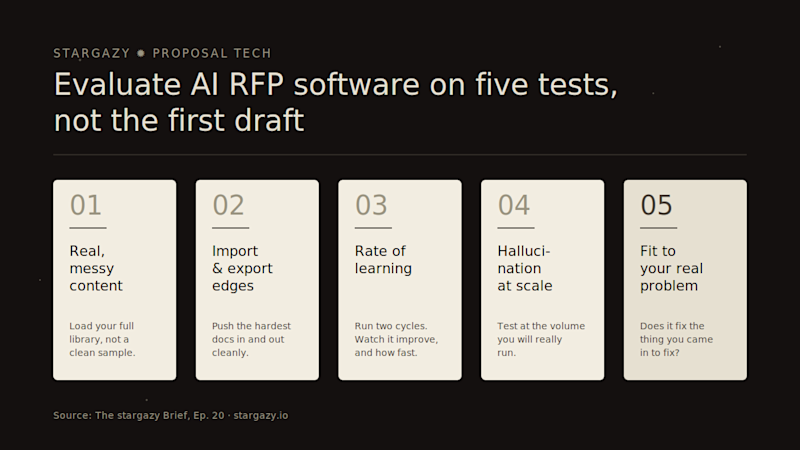
To evaluate AI RFP software properly in a demo or proof of concept, you need to test five things specifically:
-
Load your real, messy content at full scale rather than a clean sample.
-
Push your most complicated RFP documents through import and export.
-
Watch how fast the tool learns across 10+ response cycles.
-
Check whether it hallucinates more or less when it uses ALL of your content.
-
Confirm it solves the specific problem you started with.
We built this PoC testing point of view, partly based on a conversation with someone who has run these evaluations from the vendor side with more than 200 companies, and he says the failure points below are the ones buyers consistently miss.
Why do AI RFP software demos look better than real use?
Over the past year, vendors have standardized the proof of concept into a single move. Upload three past responses, and then look at the generated first draft. Although this is a fair starting point to see what the RFP software can do, it has also narrowed evaluation down and away from everything that determines whether the tool works for your team in real life. A clean three-document sample is built to make the draft look good. Your real environment is thousands of messy Q&A pairs from an old system.
Even vendors concede this. Procurement Sciences, an RFP platform itself, states that the only reliable way to evaluate the software is against a real solicitation, because demos hide workflow friction. Read their post.
Don't stop at the first draft
The first-draft test is easy, and every vendor optimizes for it. So you have to dive deeper. If you have the time and resources, put far more content into the system than the tidy three-document sample, including the messy, real-world material your team works with every day.
What content should I load into an RFP software PoC?
Load your real library, not the curated sample. A demo against a clean sample is a completely different experience from watching the tool handle thousands of your real Q&A pairs imported from your old system. Use whatever organizing structure the platform offers, whether tags, folders, or hierarchy, and plug in a few different source systems during the PoC. This is the only way to see how it behaves at your real scale and mess.
Where does AI RFP software break, and how do I test it?
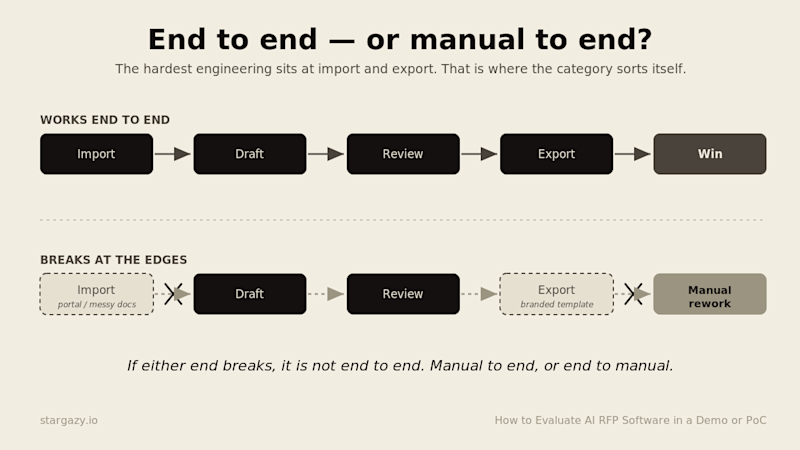
It breaks at import and export, so test the very start and the very end, too.
On import, can it pull in your documents, portals, and most complex examples cleanly and in a way that makes sense? On export, can it output the way you need, branded into a proper proposal template, and back into the customer's own document while keeping their formatting?
The same vendor notes that some platforms handle highly structured solicitations well but break down when requirements are buried across narrative sections. That is exactly the kind of failure a clean sample hides.
Tools that win on people-and-experience content, like Flowcase for AEC and professional services, or that live inside an existing environment, like QorusDocs inside Microsoft 365, will behave very differently here than a clean-slate AI drafter. Test against your formats, not theirs.
Step off the guided path
Vendors will walk you through the platform exactly as they want you to see it, toward whatever benefits them for the fastest close. Follow that script once to see the intended experience, then step outside the guardrails. Click buttons yourself. Try the features that sit off the core beaten path, the ones you wouldn't touch daily, so you don't discover in a real, built-out scenario that the button isn't there or the output drops in a way you didn't expect.
How do I test whether an AI RFP tool learns?
Test the rate of improvement, not the starting quality. The old "1% better each day" idea compounds fast, and you can see that compounding even in a quick test. Upload one response and see how it generates. Work the draft as a team, approve it, and complete your full review loop as per usual. Run another, similar response where you would expect the learnings to carry through. Then watch whether it improves, and at what rate. A tool that starts at 60% and climbs beats one that starts at 80% and stays flat - or gets worse - and some of them absolutely will get worse over time.
Does AI proposal software hallucinate, and how do I test it?
There is no single rule, so test at the scale you will run. Some systems hallucinate more as content grows, because the volume gets confusing. Others hallucinate more with very little content, because there is not enough to grasp at. Then there are bid/no-bid and qualification-first tools, like Arthurian Labs, which put a scored layer before drafting, which changes where errors and hallucination might show up (aka. in more than just your response.). So run your test at the volume you will actually operate, not the demo volume, and through every stage you expect it to take care of within your proposal process.
Anchor every test to the problem you're trying to solve
Be clear about what you are struggling with, and check whether the tool fixes that specific thing. If it does something else impressive that you love but doesn't solve your real problem, it's not the right software for you. You set the evaluation criteria. Don't let a vendor redefine them mid-demo for you. For a structured way to define those criteria across the field, the 2026 Proposal & Bid Software Report covers 51 vendors across five categories.
Why this matters for both sides
A deeper PoC is your buyer protection. But a buyer who evaluates honestly against real needs stays longer, churns less, and wastes neither side's time or money. Across Loopio's 2026 trends data and APMP benchmarks, the average team now runs 166 RFPs a year at roughly 25 hours each, so the cost of choosing wrong dwarfs any licence fee.
✹
Frequently asked questions
How long should an RFP software proof of concept take?
Long enough to load real content and run two full response cycles, which usually means two to four weeks rather than a single demo call. A 45-minute walkthrough shows you the happy path. It does not show you import friction, learning rate, or how the tool behaves at your real volume, and those are the things that decide whether the rollout succeeds.
What is the single biggest mistake buyers make when evaluating AI RFP software?
Deciding on the first draft. Vendors have standardized the proof of concept down to "upload three documents, look at the draft, decide," because that one test is the easiest to make look good. The draft tells you the tool can write a sentence. It tells you almost nothing about import, export, learning, or fit to your actual problem.
How do I know if AI RFP software will hallucinate on my content?
Test it at the content volume you will actually run, not the demo volume. Some systems hallucinate more as the library grows and the volume gets confusing. Others hallucinate more with very little content, because there is not enough to ground an answer. The only way to know which pattern applies to you is to load your real library and watch.
Should I use a real RFP or a sample during the PoC?
A real, recent RFP, and your real content library behind it. A clean sample is built to flatter the tool. Your live environment is thousands of messy Q&A pairs from an old system, complex source documents, and a real submission portal, and the gap between the two is where buyer regret lives.
What does "end to end" mean in proposal software?
It means the tool handles the work from import through to export without forcing you back into manual effort at either edge. Many platforms draft well in the middle but stumble on bringing your hardest documents in, or on exporting into a branded template and back into the customer's own formatting. If either end breaks, not end to end. Manual to end, or end to manual.
How much does AI RFP software cost, and does PoC depth change the value?
Pricing ranges from published per-seat plans to five-figure annual enterprise contracts, and many vendors gate it behind a demo. The harder number to ignore is the cost of getting the choice wrong. With the average team running well over 100 RFPs a year at roughly 25 hours each, a tool that fails at your real scale wastes far more than its licence fee. A deeper PoC is cheap insurance against that.
✹
Sources
-
Procurement Sciences, "RFP Response Software: How Modern Tools Streamline Proposal Workflows," 2026. https://www.procurementsciences.com/blog/rfp-response-software
-
Loopio, "38 Statistics on RFP Win Rates & Proposal Management," March 2026. https://loopio.com/blog/rfp-statistics-win-rates/
-
Bidara, "RFP Statistics 2026: Average Win Rate Is 45%," April 2026 (compiled from Loopio, Responsive, GAO, and APMP). https://www.bidara.ai/research/rfp-statistics
-
stargazy, 2026 Proposal & Bid Software Report (51 vendors across five categories). https://stargazy.io/proposal-tech

Christina Carter
I’m the founder of stargazy, the intelligence network for capture and proposal professionals. With 15+ years of running presales and proposal teams for B2B Enterprise, UK Public Sector, and US GovCon around the globe.