European defense procurement doubled. Bid teams didn't.

Published on March 19, 2026
The procurement surge that nobody staffed for
European defense budgets have increased for ten consecutive years. That sentence has appeared in enough policy briefs to feel routine. It should not. The rate of increase since 2022 is without precedent in the post-Cold War period. Defense investments across EU member states grew 42% in a single year in 2024, reaching a record €106 billion. Procurement spending hit €88 billion, with projections above €100 billion for 2025. Research and development spending rose 20% to €13 billion in 2024, with €17 billion expected in 2025.
The European Commission's ReArm Europe plan targets €800 billion in defense spending by 2029. NATO allies agreed at The Hague in June 2025 to raise defense spending to 3.5% of GDP for core requirements by 2035, inside a broader 5% target that includes security-related spending. Poland already spends above 4% of GDP. Germany's defense budget rose 18% in 2025 alone. Denmark, Finland, Norway, and Sweden hit a combined $53.7 billion, more than double their 2020 levels.
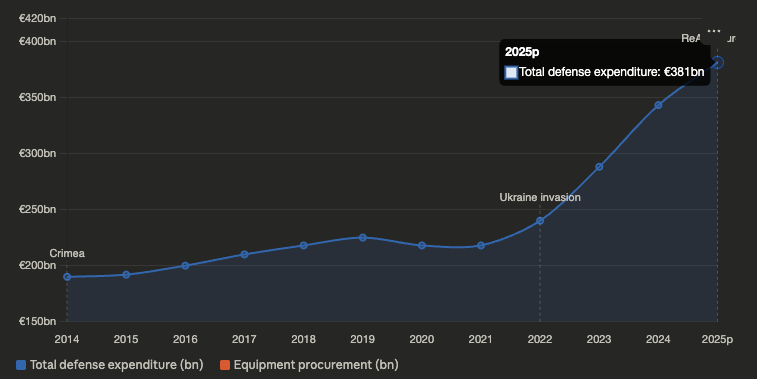
Every one of those budget lines eventually becomes a tender. Tender volumes are rising across air defense, naval procurement, land systems, ammunition, IT modernization, and support services. A 55% European sourcing mandate by 2030 will redirect contracts that previously went to US suppliers toward European manufacturers, creating an entirely new layer of competitive tender activity that did not exist five years ago.
Bid teams across Europe did not receive a matching headcount increase. Defense proposal operations are specialist functions with long ramp-up times. You cannot hire a cleared, experienced tender manager in the time it takes a procurement authority to issue an ITT.
The result is predictable - the same teams are being asked to evaluate and respond to twice the volume, with the same number of people, under the same deadlines.
Why the old evaluation model held together (and when it stopped)
Manual tender evaluation worked when the pipeline was narrow enough for senior staff to read every document. In a European defense market running at 2014 spending levels, a mid-tier contractor might see 30 to 40 relevant tenders per year. A bid director, two proposal managers, and a rotating pool of subject matter experts could evaluate each one in enough depth to make an informed go/no-go decision within a week. That pace allowed time for the human judgment that defense procurement demands, like reading between the lines of evaluation criteria, assessing incumbency risk, gauging compliance burden against available technical evidence.
The model breaks when volumes increase without proportional capacity. A bid team that could properly evaluate 40 tenders per year cannot properly evaluate 80. It can attempt 80, but the quality of each evaluation degrades. Compliance checks get compressed. Go/no-go decisions get made on gut feel rather than structured assessment. Subject matter experts get pulled into triage work that should have been filtered before it reached them.
Automated tender triage is the process of using AI to extract requirements from procurement documentation and cross-reference them against a company's product specifications and compliance records. It produces a structured compliance matrix showing where a company meets, partially meets, or fails to meet tender requirements, enabling faster and more accurate bid/no-bid decisions.
The breakage shows up in two places. First, bid teams start declining opportunities they could have won, because they lack the hours to assess whether the fit is real. Second, bid teams commit resources to pursuits that were never viable, because nobody had time to run a proper compliance check against the company's actual product documentation. Both failures cost money. The second one is worse, because it consumes senior specialist time that could have been spent on a winnable bid.
The numbers that broke the process
A single complex defense tender, a multi-volume ITT for a radar system or an MRO contract, can run to several hundred pages of requirements, specifications, and compliance criteria across multiple documents. Evaluating one of these against a company's technical documentation, product specifications, and past performance records can take a team up to 300 hours. That figure comes from practitioners, not vendors. It accounts for document parsing, cross-referencing against internal product data, compliance gap identification, and the preparation of an initial bid/no-bid recommendation.
At 300 hours per evaluation and 80 opportunities per year, a mid-tier defense contractor would need approximately 24,000 hours of evaluation capacity just for the triage stage, before any proposal writing begins. That is roughly 12 full-time equivalents dedicated solely to reading and assessing tenders. Almost no European defense contractor staffs at that level for evaluation alone. The typical workaround is to assign evaluation to people who also write proposals, manage content libraries, or carry technical delivery responsibilities. Evaluation becomes a secondary activity, and it gets done at whatever depth time permits.
This is the capacity trap. As procurement volumes rise, the cost of missed opportunities and wasted pursuits grows faster than the team's ability to keep up. Hiring alone cannot close the gap in time, because qualified defense bid professionals are scarce and the ramp-up period for classified programs is measured in months, not weeks.
What automated tender triage actually does (and doesn't do)
Automated tender triage is a narrow function. It sits upstream of proposal writing, content generation, and submission management. Its job is to answer one question: does this tender match what we can deliver, and where are the gaps?
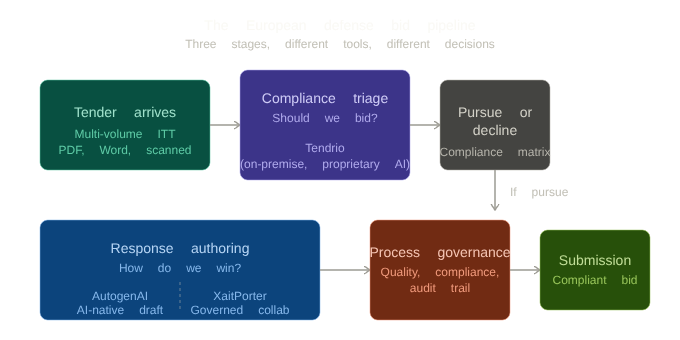
In practice, this means three things. First, extracting and structuring every requirement from the tender documentation, whether that arrives as a PDF, a Word file, a scanned document, or a spreadsheet. Second, cross-referencing those requirements against the company's existing product documentation, technical specifications, and compliance records. Third, producing a structured compliance matrix that shows where the company meets requirements, where it partially meets them, and where gaps exist, with references back to source documentation on both sides.
The output is a decision artefact, not a proposal. It tells the bid director here is what we comply with, here is where we are short, and here is the evidence for both. The bid director still makes the pursue or decline decision. The technology did the work that previously required a week of senior staff time reading and cross-referencing documents.
Tendrio, developed by CS Soft within the CSG Aerospace division of the Czechoslovak Group, is the clearest example of this approach in the European defense market. CSG is a defense-industrial group with 78% of revenue from defense-related manufacturing, operations across the Czech Republic, Slovakia, Italy, Spain, the UK, and the US, and a product portfolio that spans radar systems, ammunition, military vehicles, and aerospace MRO. Tendrio was tested internally on CSG's own procurement workflows before being spun off as a separate company. It uses a proprietary AI model trained specifically for tender analysis, rather than routing sensitive documentation through commercial LLM APIs.
The claimed performance is reducing a 300-hour evaluation to under one hour, with 90% of the analysis automated. Those numbers need independent verification (Stargazy has not conducted its own benchmark), but the directional value is clear. Even a 70% reduction in evaluation time would release hundreds of specialist hours per quarter in a mid-tier defense contractor.
Why defense is different from commercial procurement here
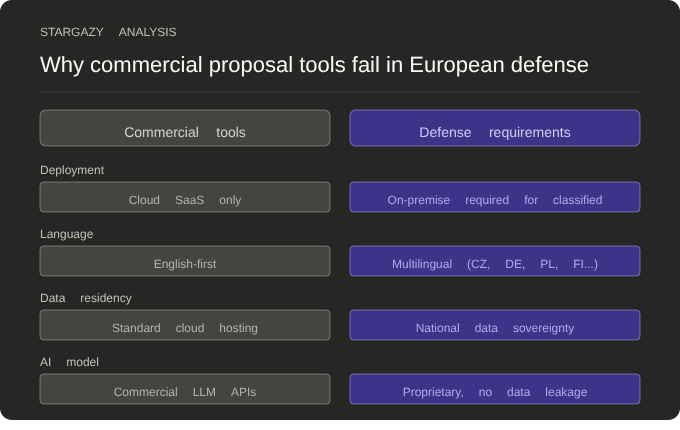
Commercial proposal teams have had access to AI-powered tools for several years. Tendium, Altura, and the newer AI-native platforms all address tender response workflows in some form. Defense bid teams have been slower to adopt for reasons that are structural, not cultural.
Tender documentation in defense carries classification and handling restrictions that prevent it from transiting through third-party cloud infrastructure in many jurisdictions. A radar procurement ITT from a NATO member state may contain Controlled Unclassified Information or national security markings that prohibit processing on servers outside the procuring nation's data sovereignty boundary. This rules out most SaaS-only AI tools for a meaningful proportion of European defense tenders.
The multilingual dimension adds further friction. European defense tenders arrive in the procuring nation's official language. A Czech manufacturer bidding on a German Bundeswehr contract, a Norwegian surveillance system supplier pursuing a Polish air defense programme, or a French avionics firm responding to a Finnish procurement; each faces a tender document in a language that may not be the company's working language. Manual evaluation in a second language is slower and more error-prone. Automated extraction and translation of requirements removes that penalty.
Tendrio's on-premise deployment option addresses the data sovereignty concern directly. For organisations that cannot send tender documentation to external cloud infrastructure, the platform runs inside the company's own environment. Its multilingual capabilities handle cross-border tender evaluation, with the ability to process tender documentation in the source language and map compliance against product documentation in the company's working language.
Triage is half the problem. The response is the other half.
Automated compliance triage solves the front end of the pipeline. It does not write the proposal. A complete European defense bid operation in 2026 needs tools for both stages, and the architecture of each stage reflects different requirements.
At the response stage, two competing philosophies are emerging across the category.
The first is AI-native proposal generation, as a system that drafts the response based on the requirements, the company's knowledge base, and predefined quality parameters. AutogenAI is the most prominent example with defense credentials. The company holds DOD accreditation, complies with CMMC 2.0 and FedRAMP technical controls, and has built a federal-specific product (AutogenAI Federal) alongside its commercial platform. European defense teams evaluating this approach should ask about data residency, on-premise availability, and language support for non-English submissions.
The second philosophy is governance-first collaborative authoring, where a platform where humans write the proposal, but the system enforces structure, version control, compliance tracking, and role-based access across a distributed team. XaitPorter, headquartered in Norway, is the strongest example in the European defense market, deeply embedded in NATO-adjacent and federal contractor workflows, bringing granular security controls, in-line commenting, and audit trails. Its strength is process governance for multi-author, multi-site proposal teams working on classified or sensitive documents. It does not generate content with AI. It governs the process around content that humans produce.
These two approaches are not mutually exclusive, and neither replaces the pre-bid triage function. A European defense bid team evaluating its 2026 toolstack should consider the pipeline as three distinct decision points:
-
should we bid (triage),
-
how do we build the response (authoring),
-
and how do we govern quality and compliance across the team (process governance).
Tendrio addresses the first.
AutogenAI and XaitPorter address the second and third from opposite directions.
What this means for European bid teams in 2026
The arithmetic is simple. European defense procurement volumes will continue to rise for the remainder of this decade. NATO's 3.5% GDP target for core defense spending by 2035 is a floor, not a ceiling. The 55% European sourcing mandate will redirect transatlantic procurement flows toward European suppliers, increasing competitive tender activity. Bid team headcount will not grow at the same rate.
The organisations that maintain or improve win rates through this surge will be those that automate the evaluation stage, concentrate expert time on pursuits with verified compliance fit, and invest in response tools that match their operational model (whether that is AI-native generation or governed human collaboration).
The organisations that continue to evaluate every tender with the same manual process will face a widening gap between opportunity volume and pursuit capacity. Win rates will decline, not because the proposals get worse, but because the wrong ones get written.
The European defense procurement market has changed structurally. Bid operations need to follow.
✹
Frequently Asked Questions
What is automated tender triage in defense procurement?
Automated tender triage uses AI to extract requirements from tender documentation, cross-reference them against a company's product and compliance records, and produce a structured compliance matrix. It tells bid teams whether to pursue a tender before committing proposal resources.
Why can't European defense teams use standard commercial proposal tools?
Many European defense tenders carry classification or handling restrictions that prevent documents from transiting through third-party cloud infrastructure. Multilingual requirements, on-premise deployment needs, and data sovereignty rules make commercial SaaS tools unsuitable for a large proportion of defense procurement.
How much time does manual tender evaluation take in defense?
A complex defense tender evaluation, covering a multi-volume ITT for systems like radar or MRO contracts, can take a team up to 300 hours. This includes document parsing, cross-referencing product documentation, compliance gap identification, and preparing a bid/no-bid recommendation.
What is the difference between tender triage and proposal writing tools?
Tender triage sits upstream of proposal writing. It answers whether to bid. Proposal tools handle the response itself, either through AI-native content generation (e.g. AutogenAI) or governance-first collaborative authoring (e.g. XaitPorter). A complete defense bid stack addresses both stages.
How much is European defense spending expected to grow?
EU member states spent €343 billion on defense in 2024, projected to reach €381 billion in 2025. NATO allies committed to 3.5% of GDP on core defense spending by 2035. The European Commission's ReArm Europe plan targets €800 billion by 2029.
✹
An Editorial Note for You, My stargazy Readers
-
AutogenAI and XaitPorter are framed as competing philosophies, not ranked. This page presents AI-native generation and governance-first collaboration as distinct architectural choices. Neither is positioned as superior, as we believed it depends on your use case.
-
All spending data on this page sourced from EU Council, NATO, EDA, McKinsey, and IISS. We have not provided vendor-reported market sizing.

Christina Carter
I’m the founder of stargazy, the intelligence network for capture and proposal professionals. With 15+ years of running presales and proposal teams for B2B Enterprise, UK Public Sector, and US GovCon around the globe.