AEC Proposal & Marketing Teams: Are You Focusing on the Right Thing?

Published on April 13, 2026
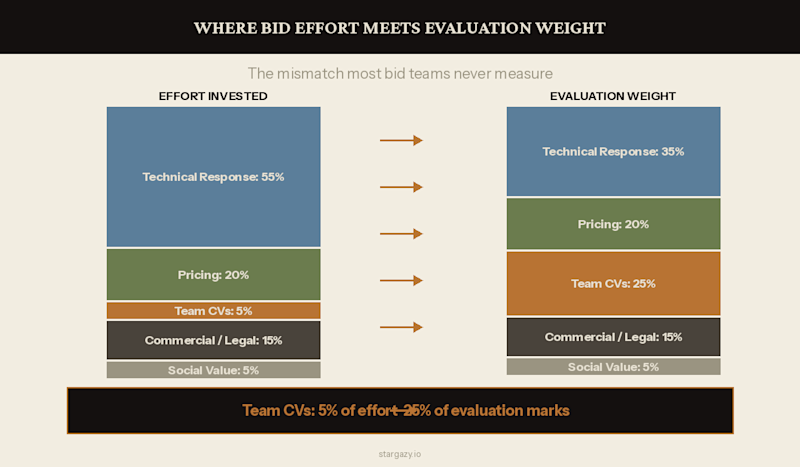
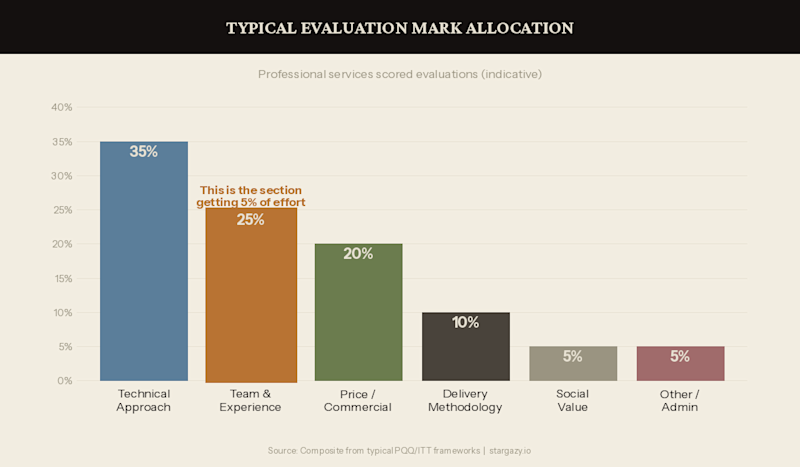
The team section of a scored proposal typically carries 20-30% of the total evaluation marks. In some AEC and consulting procurements, it can go higher. And at most professional services firms, it is the last section to be assembled, using CVs that nobody has updated since the previous financial year.
That gap between what evaluators weight and what bid teams invest in is where marks go missing. Firms pour 80% of their effort into the technical approach, then hand evaluators a set of CVs pulled from a shared drive at 11pm the night before submission. The result is the strong technical scores are dragged down by mediocre team scores, on a section that was fully within the firm's control.
The invisible 25%
Bid Directors know the team section matters. They write it into every bid plan and flag it at kick-off. And then, when deadline pressure builds, the team section becomes the thing that gets done last, done fast, and done with whatever CVs happen to exist.
The failure mode is predictable. The proposed project director's CV was last updated eighteen months ago. It lists their previous employer's projects but not the two major wins from this year. The proposed QA lead's CV is in a different template from everyone else's because they joined from an acquisition and nobody migrated their documents. The formatting varies across six CVs from four offices, and the bid coordinator is reformatting them at midnight eating cold pizza because the client specified a two-page limit and half the team submitted four pages.
None of this is a skills problem, and the firm has the right people. The problem is that the firm cannot prove it on paper, under time pressure, in a format evaluators can score.
What the numbers say
Flowcase, a CV and resource profile management platform for professional services firms, found that when firms onboard to their system, over 70% of employee CVs have not been updated in more than a year. These are firms actively bidding on projects where the team section is worth a quarter of the total score.
That figure deserves attention.
A firm investing 200 hours in a bid response, where 25% of the marks sit on the team section, is effectively risking 50 marks' worth of evaluation on documents that are a year out of date. The technical response gets reviewed, workshopped, red-teamed, and polished. The CVs get copied from wherever they were last saved.
Flowcase's 2025 Professional Services Bid Management Report adds further context. Only 2% of surveyed firms reported win rates above 80%. The report identified tailored content, including customised CVs and case studies, as a consistent differentiator between firms that win and firms that finish second. Firms that match the right resources to the project and present them well outperform firms that submit generic documentation.
"Most firms don't lose marks on the team section because they lack experience, they lose them because they can't prove it. When firms onboard with us, we often find that over 70% of their employee CVs haven't been touched in over a year. These are firms competing for projects where the team section is worth 25% of the score. They're investing heavily in writing the best proposal, but then handing evaluators an out of date resume and project sheet from 2022." — Erling Linde, CEO of Flowcase
Where this sits in the category
Proposal technology has historically focused on the response itself, like content libraries, AI-powered answer generation, compliance checking, and document assembly.
CV and resource profile management sits upstream of the response. It is a distinct operational problem that most proposal platforms either ignore or handle as a secondary feature, usually as a dedicated tool for professional services firms, covering management consulting, IT consulting, engineering, construction, law, and architecture.
The tool centralizes employee CVs and project references in a searchable database, allows bid teams to tailor content to specific RFP requirements, and exports formatted documents that match client templates. For firms responding to SF 330 forms, FIDIC formats, or bespoke public sector templates, this removes the manual reformatting step that eats hours on every bid.
Stargazy's 2026 Proposal & Bid Software Report covers the full category landscape, but the CV management gap is one area where many enterprise firms remain underserved. Most proposal platforms assume the CVs already exist in usable form. For professional services firms, that assumption is wrong.
The honest assessment
By focusing on CV and project reference management rather than trying to cover the entire proposal lifecycle, the platform keeps the people-and-projects data current, searchable, and formatted for bid use. For firms running 50 or more bids per year across multiple offices, the time savings compound quickly.
The limitation is scope. Tools like Flowcase do not replace a proposal content library or an AI response tool. It sits alongside those systems as a complementary layer. For firms that have already invested in a platform like Responsive, QorusDocs, or an AI-native drafting tool, Flowcase fills the gap that those platforms leave open on team CVs and project references. For firms without any proposal technology, starting with CV management is a pragmatic entry point because the ROI is visible, the change management is low, and the effect on evaluation scores is measurable within a few bid cycles.
As procurement bodies continue to increase the weight of team qualifications in scored evaluations, and as more firms adopt tools that present polished, tailored team profiles, the bar rises. Submitting stale, inconsistently formatted CVs against competitors using managed, current, and RFP-specific profiles is a scoring disadvantage that compounds with every bid.
What to do about it
If you run a bid team at a professional services firm, the first step costs nothing. Pull the last ten bids your firm submitted. Check how many of the proposed team members' CVs were updated within three months of submission. Check how many were tailored to mirror the language in the RFP's evaluation criteria. Check how long the bid team spent formatting them.
That baseline will tell you whether you have a CV problem or not. If more than half the CVs were stale or generic, the team section is leaking marks on every bid. The fix may be a tool like Flowcase, a revised internal process, or both. Either way, the section carrying a quarter of your marks should not be the section getting the least investment.
For a deeper look at how proposal technology categories are evolving and where CV management fits, the full analysis is in Stargazy's 2026 Strategic Response Platforms Report. For more on The Stargazy Brief podcast, upcoming episodes will cover the intersection of AI and team profiling in professional services bids.
✹
Frequently asked questions
What percentage of evaluation marks does the team section carry in professional services proposals?
Team sections typically carry 20-30% of total evaluation marks in scored professional services procurement. In some AEC and consulting procurements, the weight can exceed 30%, particularly where the client is buying expertise rather than a product.
Why do proposal teams treat CVs as a last-minute task?
Bid teams under deadline pressure prioritise the technical response and pricing because those sections feel more complex and higher-stakes. CVs are perceived as admin rather than scored content. The result is that a section worth a quarter of the marks receives a fraction of the effort.
How often should employee CVs be updated for proposal use?
Best practice is to update CVs after every completed project and at minimum quarterly. Flowcase's onboarding data shows 70% of firms have CVs that have not been updated in over a year, which means firms are routinely submitting outdated credentials in scored evaluations.
What is proposal CV management?
Proposal CV management refers to maintaining a centralised, current, and searchable database of employee CVs and project references that proposal teams can tailor to specific RFP requirements. It removes the manual process of hunting down Word documents across shared drives and reformatting them under deadline pressure.
How does CV quality affect proposal win rates?
Flowcase's 2025 Bid Management Report found that firms with tailored content, including customised CVs and case studies, consistently outperformed firms submitting generic documentation. Given that only 2% of surveyed firms reported win rates above 80%, the team section is one area where operational improvements can produce measurable scoring gains.
What tools exist for managing CVs in proposals?
Flowcase is a dedicated CV and resource profile management platform for professional services firms. Most general-purpose proposal platforms handle CVs as a secondary feature or assume they already exist in usable form. Stargazy's proposal technology directory at stargazy.io/proposal-tech covers the full vendor landscape.
✹
Sources
Flowcase, 2025 Professional Services Bid Management Report, flowcase.com/bid-management-report
Flowcase, "What's A Good Proposal Win Rate in 2025," flowcase.com/blog/whats-a-good-proposal-win-rate-in-2025
Flowcase, "Optimizing Resume and CV Terminology for Higher-Scoring Proposals," flowcase.com/blog/optimizing-resume-cv-terminology-for-higher-scoring-proposals
Flowcase, "Proposal Automation Tool for CVs, Resumes and Case Studies," flowcase.com/blog/proposal-automation-tool-for-cvs-resumes-and-case-studies
Stargazy, 2026 Strategic Response Platforms Report, stargazy.io/resources

Christina Carter
I’m the founder of stargazy, the intelligence network for capture and proposal professionals. With 15+ years of running presales and proposal teams for B2B Enterprise, UK Public Sector, and US GovCon around the globe.