Why Teams Are Moving Beyond Legacy Software and ChatGPT for RFPs

Published on February 26, 2026
by David Burton
We keep seeing the same pattern.
A team gets hit with a surge of RFPs or security questionnaires. If they’re using legacy RFP response software, it struggles to keep up. The workflow exists, but the content layer decays. Teams are already overloaded, so maintaining the proposal knowledge base becomes secondary. Over time, answer quality drops. But when they try to use ChatGPT or Claude, they have to manually copy the question into a chat window, dig through Google Drive or SharePoint for the relevant source material, paste it in, and generate an answer. Then repeat 200 times.
Legacy RFP software enforces structure without intelligence.
ChatGPT provides intelligence without structure.
And in both cases, there’s no continuous improvement loop inside the system.
What Happens When Volume Outpaces Infrastructure
This is the moment most teams recognize the real problem.
A lean security team handling 4–5 questionnaires a week suddenly sees demand double. Each response takes 2–3 days, and although their existing compliance software has "automation," it wasn’t designed for this level of repetition, and it breaks under pressure.
They try ChatGPT. It helps, but it’s still far too manual because they have to copy the question, find source material, paste, edit, and repeat. There is no system memory, and no compounding benefit.
The workload increases, but the infrastructure doesn’t.
That was the position Ivo found themselves in. They simply needed a system that scaled with them.
After running the same questionnaires through five proposal software platforms side by side, they chose Arphie, because it was the one that required the least manual correction and made it easiest for a lean team to operate at speed.
The outcome was structural, and it made a noticeable difference:
-
Time per questionnaire dropped by 75%.
-
Weekly volume increased from 4–5 to more than 20.
-
New contributors required minimal onboarding.
They were finally moving from workaround automation to infrastructure-level automation.
Once the security team stabilized their process, the GTM team adopted the same system for RFPs. When the underlying system scales, the rest of the organization follows.
Read the full Ivo case study.
The Real Problem Isn’t Writing RFP Responses
Most teams assume they have a proposal writing problem, but they actually have a systems problem.
Most proposal teams are losing time managing the infrastructure that’s supposed to make drafting fast.
As a company grows and changes, its Q&A libraries grow with it. Many of these are duplicate Q&As with slightly different wordings, creating parallel answers to the same underlying question. This means compliance statements diverge, and no one fully trusts which version is correct, so they completely rewrite or start from scratch.
At scale, this becomes operationally inefficient, and that inefficiency compounds.
Arphie has seen this multiple times, so they've built something new at a systems level that fixes these problems before they begin.
Let’s walk through the top three issues most teams see in their libraries and how Arphie can help fix them
Problem 1: When Your Library Stops Being a Source of Truth
Stop Answering the Same Question Twenty Different Ways
If your team has responded to hundreds of RFPs, you likely have multiple versions of the same answer living side by side.
Different wording, with slightly different framing. Maybe a new certification was added to one version but not the others. Over time, that fragmentation erodes confidence in your library and opens you up to risk. It means review cycles increase because reviewers are reconciling inconsistencies, and SMEs get pulled in to validate language that should already be settled.
"Are you SOC 2 Type 2 compliant?" and "Is your platform SOC 2 compliant?" are the same question, but they live as separate entries with slightly different answers. "What is your disaster recovery plan?" and "How quickly can you restore service after an outage?" are the same question, as well.
The issue isn’t really duplicates. The real proposal systems and process issue is trust.
Arphie restores that trust by identifying semantically similar questions, not just keyword matches, and consolidating them into a single, authoritative response. Instead of forcing teams to manually audit thousands of entries, it surfaces clusters that clearly represent the same underlying intent and proposes a unified answer built from the strongest elements across versions.
How Arphie’s Smart Merge works:
-
Arphie scans your entire Q&A library and identifies groups of duplicate or near-duplicate entries — not just exact matches, but semantically similar questions that are clearly asking the same thing.
-
Groups are surfaced for the team to review. You’ll see each cluster of duplicates side-by-side, with the option to include or exclude specific entries from each group.
-
AI agents help generate a merge suggestion. For each group, Arphie builds the strongest, most complete response across all the duplicates, drafts a merged version, and saves all the duplicated questions as alternate question text.
-
You have full control. Review the suggested merge, edit the final answer, adjust questions, and publish when you're ready. Nothing changes in your library until you approve it.
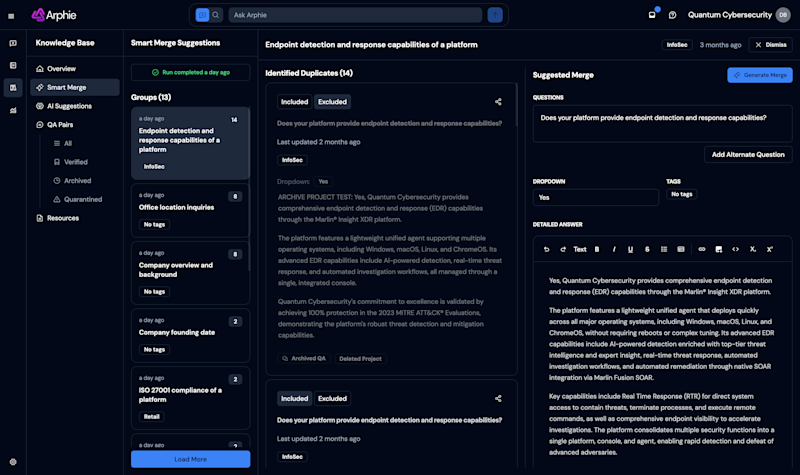
Smart Merge functionality
With Smart Merge, customers are no longer overwhelmed by their content library. Arphie helps customers restore a clean, deduplicated Q&A library where every question has one authoritative answer, without hours of manual auditing. So your team remains in control, and nothing is overwritten without a human's review. The result is a smaller, more coherent, happier content library.
One Arphie customer even reduced 11,000 entries to 1,000. The customer finally has a single source of truth.
Problem 2: Q&A Drift is Inevitable, Unless You Design Against It
Your Q&A Shouldn't Go Stale While You're Not Looking
Even a clean library decays over time.
Your products will evolve, and your certifications will change and renew. Your product marketing messaging with shift, and your policies will change. But the Q&A library doesn’t update itself just because your product did. So small (or big) inaccuracies slip in unnoticed until they show up in a live proposal.
By then, the damage is reputational.
Most teams attempt to solve this with periodic, well-intentioned audits. The problem is audits are reactive and resource-intensive.
That's why Arphie decided to treat content freshness as an ongoing system responsibility via AI Suggestions.
Teams can initiate structured updates across the library when something changes; for example, renaming a product or updating compliance language. But more importantly, Arphie monitors where the library fails to support live responses. If the system struggles to answer new RFP questions during auto-generation, that signal becomes intelligence. It identifies where knowledge gaps exist.
There are two ways Arphie’s AI Suggestions work.
The first is push-based, where the user asks the AI to act as the content library. For example, a user wants to bulk change several Q&A pairs because of a product name change from X to Y.
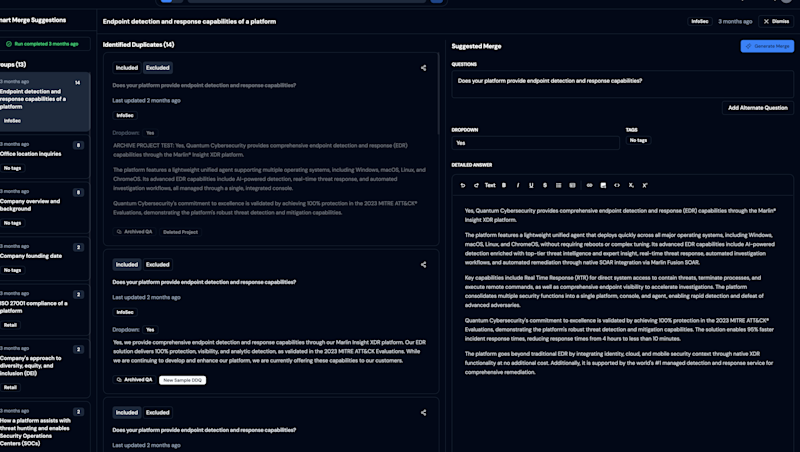
The second is pull-based. Arphie's AI agents proactively look for gaps in your Q&A library that need improving. We detect these gaps by seeing where questionnaires / RFPs are unable to be answered by our agent during autogeneration. We use that as information to understand where the content library needs to be improved. Arphie’s Knowledge Base Agent can even proactively send an email to the relevant stakeholder to ask for the information and integrate this into the library.
Arphie just released the pull-based Arphie AI suggestions feature in closed beta, and we’re seeing teams move even faster with this proactive content management. Arphie is helping their response team customers deal less with audits that don’t scale and incorrect responses that show up in a live RFP.
Problem 3: The Hidden Cost of Proposal Workflow Friction
Turning Chat Into Action
In any RFP platform (AI native or legacy), completing a proposal from end-to-end will involve a certain number of clicks. Assign this section to Sarah. Review a response and edit it. Mark it complete.
Every platform, AI-native or legacy, requires users to understand how to operate it before they can contribute effectively. But for the team responsible for responding to RFPs and questionnaires, that onboarding burden falls heavily on them.
What what really happens is an SME will only respond in Slack instead of figuring out a new software, so the proposal manager copies the answer manually, and the version in the platform never updates. And then you repeat this same cycle in the next RFP.
That’s why Arphie designed their system to be used conversationally. So instead of requiring users to navigate through menus and toggles, users can instruct Arphie in plain language.
Examples of actions Arphie’s Operation Agent can take:
-
Assign questions: "Assign all the security questions to the InfoSec team"
-
Autogenerate responses: "Generate answers for Section 3"
-
Mark items complete: "Mark all of Sarah's completed questions as done"
-
Navigate and take action: "Show me all unanswered questions in the compliance section"
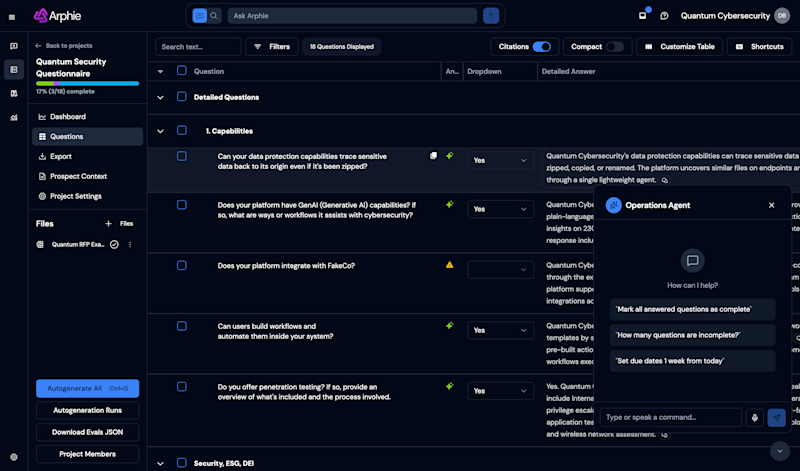
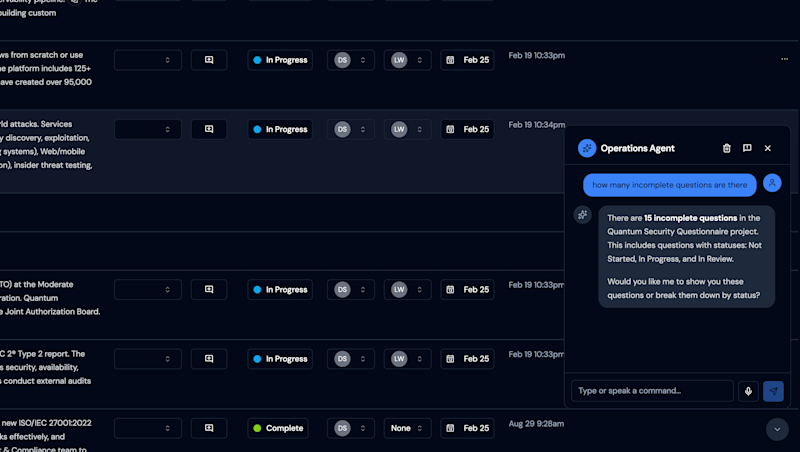

This UI and interaction design is important because it lowers activation energy so SMEs can contribute to responses without needing a training session. And then power users move faster because intent translates directly into action.
It combines the familiarity of conversational AI with the structure and controls required in enterprise proposal workflows.
Day in the life: The SME who doesn't have time for another platform
You're a solutions architect. It's Wednesday afternoon and the proposal team just assigned you 5 questions on a security questionnaire. You've never logged into Arphie before. You don't have time to learn a new platform. You just need to answer these 5 questions and get back to your actual job. You open Arphie through a one-click SSO invitation, and instead of hunting through menus and tabs, you type into the Operations Agent:
"Show me the questions assigned to me."
All five appear. The first one is data encryption. The AI has already generated a first draft pulled from your company's actual architecture docs. It's 90% right. You type:
"Update question 1. We also encrypt data in transit using TLS 1.3, not just 1.2. And mention that we rotate encryption keys quarterly."
Done. The other 4 questions look good. You type:
"Approve the other 4 questions assigned to me"
No training session, no clicking through unfamiliar navigation, no Slack message to the proposal team asking "where do I find my assigned questions?" You just had a conversation with the platform and it did the rest.
Power users will likely want to continue to use our UI, but we know the pain of having to learn a new platform. The point of the operations agent is to decrease the friction of moving through an RFP. Sometimes it’s smartest to just talk to it.
Tying It Together
These three features solve different problems, but they come from the same insight: the hardest part of RFP response is maintaining the whole system so that high-quality data leads to high-quality answers… which in turn leads to winning deals.
Feature | What it solves |
Smart Merge | Duplicate QA pairs cluttering your library |
AI Suggestions | Outdated answers slipping into responses |
Operations Agent | Accelerating the platform learning curve for users and SMEs |
It's the duplicate QA pairs that make your team second-guess which version is the "right" one. It's the answer that was accurate when it was written 8 months ago but doesn't reflect the certification you renewed or the feature you shipped since. It's the friction of navigating an unfamiliar platform.
Smart Merge cleans up the debt that accumulates in any content library over time. AI Suggestions monitors your knowledge base against your actual source-of-truth documents so nothing goes stale without someone knowing about it. An Operations Agent removes the friction between knowing what needs to happen and actually making it happen inside the platform.
Together, they move Arphie from a tool you use to generate first drafts, into infrastructure that actively maintains the quality of your knowledge base and accelerates the workflow around it.
Want to See This in Action?
If you’re evaluating RFP automation software and want to see how Smart Merge, AI Suggestions, or Operations Agent would work inside your proposal knowledge base, let’s chat.
You can see how AI proposal management works in practice and request a workflow review from hello@arphie.ai, or reach out at arphie.ai/contact.
