What a good federal proposal win rate looks like in 2026, and why writing capacity is rarely the problem

Published on September 7, 2026
Independent analysis by Christina Carter, founder of stargazy, drawing on the 2026 Proposal & Bid Software Report and published benchmark data from Deltek, Unanet and CohnReznick, GAO and the SBA. GovDash is a stargazy Orbits partner. Sponsorship is disclosed and never buys coverage.
A defensible competitive win rate for a federal contractor sits between 25% and 50%, depending on contract type, company size and incumbency position. The firms above that band, and the firms below it, differ mainly in what they decline to bid.
Deltek's 2026 GovCon Clarity study puts the average federal proposal at 84 hours of effort and reports a 72% win rate for top performers against a 48% industry average. The Unanet and CohnReznick GAUGE Report, published in June 2026, finds that 37% of federal contractors win 25% or less of what they submit.
Adding writing capacity to a team in that bottom band multiplies a losing ratio at a lower cost per loss.
What is a good federal proposal win rate?
A good federal win rate is above 30% on competitive full-and-open work and above 50% on recompetes you already hold. Anything below 25% on new business signals that your company may have a selection problem.
Deltek's 2021 Clarity study reported a 40% average new-bid win rate.
RWCO's 2019 industry barometer called 30% the new normal, with IT and professional services firms near 50% and defense firms often below 25%.
Grant Thornton's contractor survey landed at 30%.
The 2026 GAUGE Report shows only 27% of firms winning more than half of their proposals.
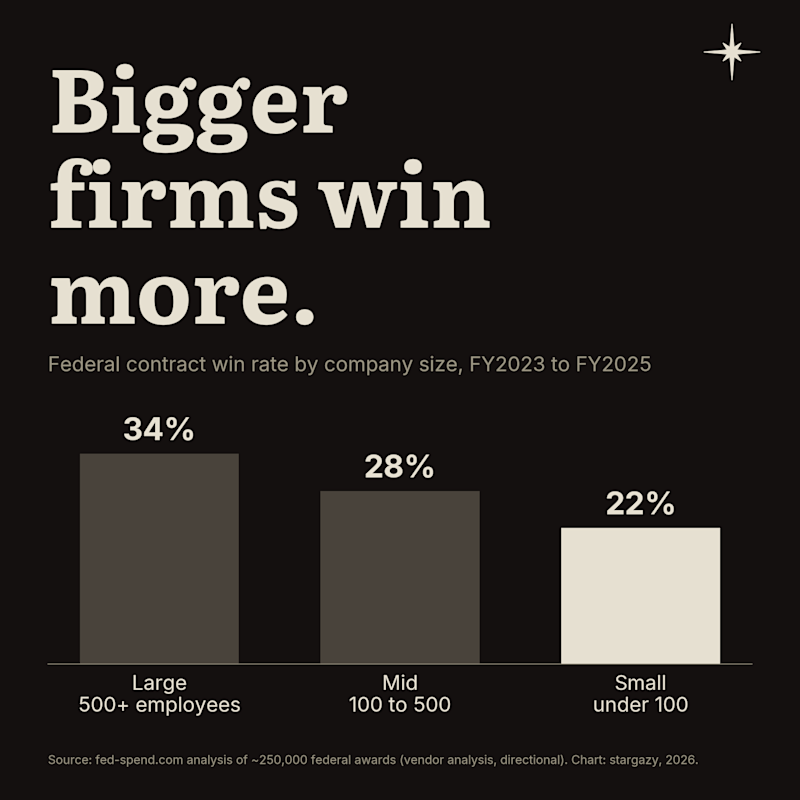
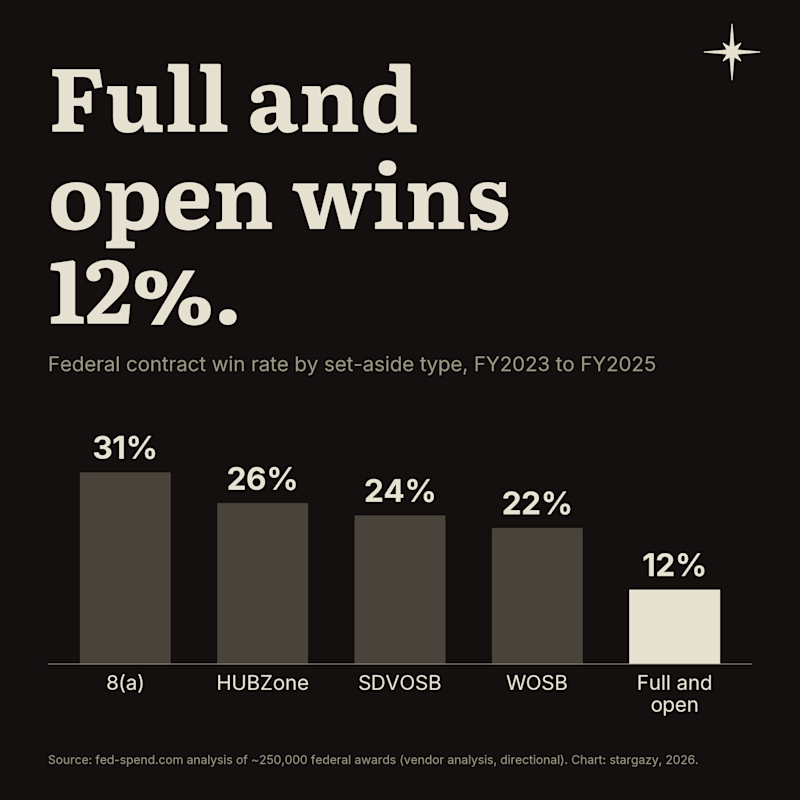
But the award-level data from fed-spend.com, drawn from roughly 250,000 awards across FY2023 to FY2025, shows the structure underneath those averages.
Large firms with more than 500 employees win 34% of what they bid, mid-sized firms 28%, and small firms 22%.
By set-aside, 8(a) firms win 31%, HUBZone 26%, SDVOSB 24% and WOSB 22%, against 12% on full-and-open competition.
Under LPTA evaluation, the lowest bidder wins 89% of the time; under best value the lowest bidder wins 34% of the time, and high technical scores win 2.3 times more often.
The real problem is the dataset is a vendor analysis rather than peer-reviewed research, and we have to read it that way.
Why does bidding more lower your win rate?
A firm raises its win rate faster by discarding the losers than by picking the winners.
Firms that describe themselves as bidding on everything average a 12% win rate.
Firms with a formal bid/no-bid process average a 28% win rate.
Incumbents win roughly 72% of their rebids, so a challenger against an entrenched incumbent wins roughly 18%. Where there is no incumbent, the figure sits near 31%.
The pursuits that do the damage are the gray bids, with the 40% to 70% probability opportunities that receive a reflexive yes because the pipeline report needs something more than it already has. But at 84 hours each, a dozen gray bids a year consumes a full quarter of a proposal manager's capacity on work the firm never expected to win.
When is writing capacity the real constraint?
Writing capacity is the binding constraint in two cases:
Task-order velocity inside a vehicle a firm already holds. Once a firm is on an IDIQ or a GWAC, orders drop with short fuses and minimum-activity expectations, and selectivity at the order level can cost the seat on the vehicle itself.
The young small business. A firm under ten years in the market averages a win rate near 20%, and it needs volume to build the CPARS record that lifts future probability. For that firm, a disciplined no-bid process still applies, but the threshold sits lower because the past-performance return on a loss is real.
Outside those cases, the argument for capacity usually reduces to the executive line, "If we don't bid, we can't win."
Instead, ask yourself, "Would the last three losses been won by a better written proposals?" If so, your winning constraint is your proposal team's capacity.
But, if the last three losses were foreseeable from the incumbency position and the evaluation criteria, the constraint is your qualification gate decisions.
What belongs in a federal bid/no-bid decision matrix?
A federal bid/no-bid matrix needs a qualification rubric that your team really and truly follows on a consistent basis.
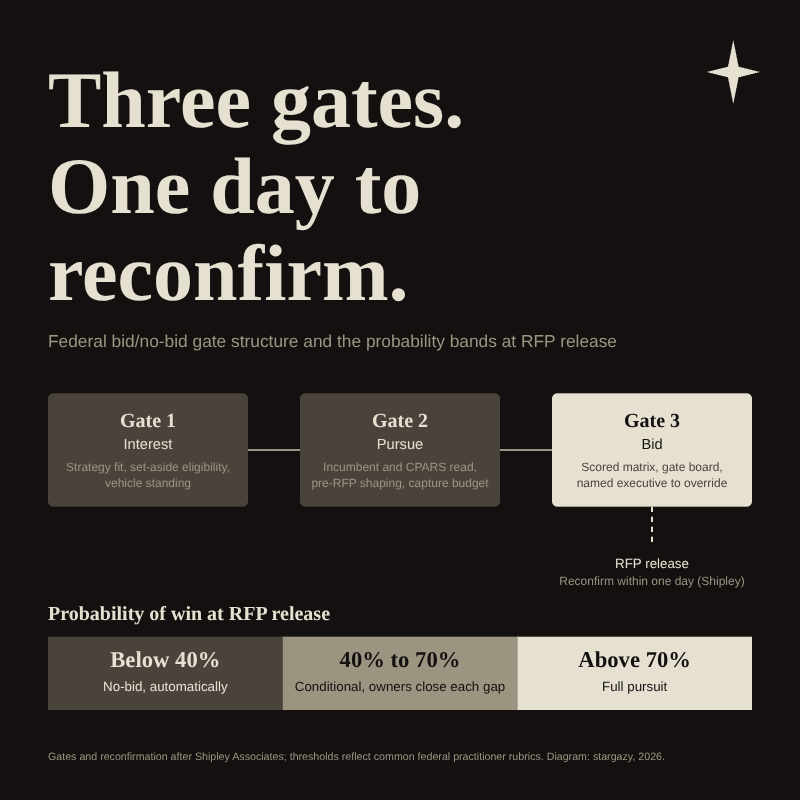
The Shipley business development lifecycle places formal go/no-go gates across a seven-phase process and prescribes reconfirming the proposal decision within a day of receiving the solicitation, because the customer's final requirements routinely differ from the draft the capture team planned against.
The APMP Body of Knowledge frames the same decision as a resource allocation, since every bid commits hours that another pursuit could have used.
Common practitioner thresholds treat a probability of win below 40% as a no-bid, 40% to 70% as conditional with named owners assigned to close each gap, and above 70% as a full pursuit.
A low score early in capture is acceptable. A low score at RFP release is a signal to walk away.
The following criteria appear in almost no downloadable templates, even though they decide almost every federal outcome.
Criterion | Question the gate must answer | Why generic templates miss it |
Incumbent position | Is there an incumbent, and what does its CPARS record show? | Cross-industry templates have no concept of a 72% incumbent rebid rate |
Set-aside eligibility | Does the firm qualify today, and will it still qualify at award after any size recertification? | Eligibility shifts with revenue and headcount |
Evaluation basis | LPTA or best value, and where does the firm's price sit against the likely field? | Determines whether technical writing can move the outcome at all |
Vehicle standing | Does a no-bid put a seat on an IDIQ or GWAC at risk? | Vehicle obligations are unique to federal work |
Pre-RFP contact | Did the firm shape requirements or attend industry day before release? | Most templates score customer intimacy generically |
Protest exposure | Is the award likely to be protested, and can the firm absorb the delay? | GAO effectiveness rates run near 52%, so delay is common |
Who holds the authority to say no?
The failure modes repeat across firms of every size.
Business development overrides the score to stay visible with an agency. The customer asked us to bid, which is treated as evidence of probability, when it is usually evidence of a procurement office building a competitive range.
An executive protects a pet pursuit. A team that has already spent capture money treats the spend as a reason to continue. A proposal team with a lull (or not!) is handed a low-probability bid to keep it busy, which is the most expensive form of idle time a firm can buy.
The structural answer in the firms above the 50% line is consistent. The matrix is scored by capture, reviewed by a gate board that includes finance, and a score under the threshold moves the pursuit to no-bid automatically.
Does AI proposal software improve win rate?
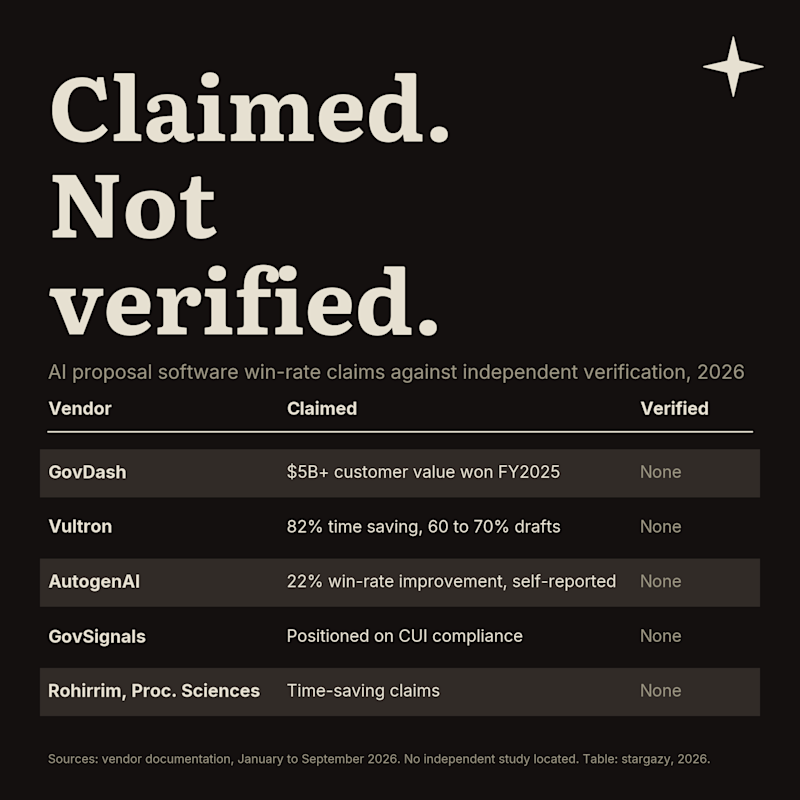
AI proposal software has demonstrably reduced drafting time. No independent evidence yet shows it raises win rate.
Vendor | Best fit by stargazy's criteria | Federal data posture | Published outcome claim |
GovDash | Firms consolidating capture, proposal and contract management on one AI-native platform | FedRAMP Moderate equivalency | $5B+ customer contract value won in FY2025; no win-rate lift published |
GovEagle | Service firms wanting compliance matrix, outline and draft generated inside Word and Excel | FedRAMP Moderate Authorized | 50%+ proposal time cut; pink-team draft in 60 minutes; no win-rate lift published |
AutogenAI | Enterprise bid teams operating across federal and commercial work | FedRAMP High | 22% win-rate improvement, self-reported |
GovSignals | Defense contractors handling CUI in the drafting workflow | FedRAMP High | Positioned on compliance rather than outcome |
Rohirrim, Procurement Sciences | Firms wanting drafting assistance without a full platform migration | Varies by product | Time-saving claims; no verified win-rate data |
DFARS 252.204-7012 requires cloud services that touch controlled unclassified information to meet a FedRAMP Moderate equivalent baseline, and the proposed FAR CUI rule re-issued in June 2026 would extend NIST SP 800-171 obligations to nearly every contractor handling CUI, with 72-hour incident reporting. The working rule in the market is simple. If the tool is not authorized for CUI, the CUI does not go in.
The strategic effect of cheap drafting runs against the assumption most buyers bring to it. When every competitor can produce a compliant 60% draft, compliant drafts stop differentiating. The scarce inputs revert to pre-RFP position, evaluator-facing proof and the willingness to decline. Cheap capacity makes the gate more valuable, and it raises a second risk the industry has not priced yet, a flood of good-enough AI submissions that lowers everyone's rate and deepens evaluator fatigue.
What does the 2026 federal market do to this calculation?
The 2026 market rewards selection over volume for the large majority of contractors, because the public pipeline is shrinking while the dollars concentrate.
Independent trackers count more than 10,000 federal contracts terminated, reduced or restructured since early 2025, with estimated value between $71 billion and $85 billion depending on the tracker. GSA's OneGov initiative, announced in April 2025, continues to consolidate purchasing into fewer and larger agreements. Category management and best-in-class vehicles push the same direction. SAMradar's FY2026 count through May 2026 shows about 90,900 opportunities posted publicly on SAM.gov, which the firm estimates at roughly 3% of all contract actions. The other 97% never appeared as a public solicitation.
A firm that responds to that market by bidding more is bidding harder into the least differentiated 3% of federal activity. A firm that responds by moving effort into the pre-RFP window, where the other 97% is shaped, changes its incumbency position for the next cycle. GAO's FY2025 protest data adds the timing cost. Filings fell to 1,688, the sustain rate sat near 14%, and the effectiveness rate held at 52%, so a firm should expect roughly half of protested awards to produce corrective action and delay.
What should each role change first?
The business development director should change the number the firm measures from submits to qualified submits, defined as pursuits that passed the gate above threshold. Submit counts reward the 12% cohort's behavior.
The capture director should move the effort the firm recovers from AI drafting into the pre-RFP window and defend the gate at RFP release, since that reconfirmation step is where the Shipley process most often collapses into a hallway conversation.
The proposals director should treat recovered hours as budget for positioning and proof on the pursuits that cleared the gate, and should hold the line on gray bids rather than absorbing them because the tooling now makes absorption possible.
✹
Frequently asked questions
What is the average federal contractor win rate?
Published averages range from 20% to 48% depending on the study and the definition. Deltek's 2026 Clarity study reports a 48% industry average and a 72% top-performer rate. The 2026 GAUGE Report finds 37% of firms winning 25% or less of their submissions.
How much does it cost to write a federal proposal?
Deltek's 2026 Clarity study puts the average proposal at 84 hours. Practitioner estimates of proposal cost run from 2% to 5% of awarded contract value, rising above 10% on complex pursuits, and a 2012 American Express survey put the average small-business cost of securing a federal contract at $128,628.
What is a good Pwin threshold for a no-bid?
Most federal practitioners treat a probability of win below 40% at RFP release as a no-bid, 40% to 70% as conditional on closing named gaps, and above 70% as a full pursuit. A low score early in capture is normal; a low score at release is the walk-away signal.
Do AI proposal tools improve win rates?
Vendors report time savings between 50% and 82% and, in AutogenAI's case, a 22% win-rate improvement. No independent study has verified a win-rate effect for any federal AI proposal tool as of September 2026.
How many proposals should a small business bid per year?
There is no published benchmark. The evidence favors setting the number from the gate rather than from a target, since firms that bid everything average 12% and firms with a formal process average 28%. A young firm building CPARS can justify a lower threshold, not a higher volume target.
Which widely repeated figures are poorly sourced?
Three numbers circulate through vendor content without a verifiable origin. The 30% rule has no single identifiable source. The 60/30/10 split of pursuit budget across capture, proposal and post-submission is a practitioner heuristic. The claim that 80% of the decision is made before the RFP is released is repeated as fact and has never been measured. Each may be directionally right; none should appear in a board deck with a citation.
For the full diagnostic across 14 win-capability metrics, see the Win Intelligence Assessment.
✹
Sources
Deltek, GovCon Clarity Report 2026 (17th annual), 2026, https://www.deltek.com/en/government-contracting/clarity
Unanet and CohnReznick, GAUGE Report, June 16, 2026, https://unanet.com/gauge-report
Washington Technology, coverage of the 2026 GAUGE Report, July 2026
fed-spend.com, federal win rate analysis of FY2023 to FY2025 awards, 2026 (vendor analysis)
Lohfeld Consulting, blog series on bid decisions and win rate, 2011 onward, https://lohfeldconsulting.com/blog/
RWCO, Industry Barometer survey press release, 2019,
OCI, Cost to Prepare a Proposal, https://ociwins.com/government-proposal-consultants/cost-prepare-proposal/
American Express OPEN, small business federal contracting survey, 2012, via NBC News, https://www.nbcnews.com/news/amp/wbna52672144
GAO, Bid Protest Annual Report to Congress for FY2025, December 12, 2025, and GAO-25-900611 for FY2024, https://www.gao.gov/legal/bid-protests
SAMradar, FY2026 SAM.gov opportunity count through May 31, 2026
Shipley Associates, Business Development Lifecycle Guide
APMP, Body of Knowledge, bid/no-bid decision guidance, https://www.apmp.org
DFARS 252.204-7012 and the proposed FAR CUI rule, June 23, 2026, https://www.acquisition.gov
GovEagle, FedRAMP Moderate Authorization announcement via Knox Systems, August 12, 2026, https://www.prnewswire.com/news-releases/goveagle-achieves-fedramp-authorization-through-partnership-with-knox-systems-302849193.html
Sweetspot, published product claims and security posture, 2026, https://www.sweetspot.so/
GovDash, FedRAMP Ready designation announcement, May 11, 2026, https://www.govdash.com/blog/govdash-earns-fedramp-ready-and-joins-fedramp-marketplace; FedRAMP Marketplace listing FR2617333263, https://www.fedramp.gov/marketplace/products/FR2617333263/

Christina Carter
I’m the founder of stargazy, the intelligence network for capture and proposal professionals. With 15+ years of running presales and proposal teams for B2B Enterprise, UK Public Sector, and US GovCon around the globe.