Should you hire or outsource your proposal experts?

Published on May 15, 2026
You will hit a point in scaling where ad hoc proposal work stops working. Sales is winning enough deals to attract more RFPs than the team can absorb, and win rates start sliding. Somewhere on a CRO 1:1 agenda, they get the question, "Do we hire a head of proposals or outsource the bid function?"
Most mid-market companies pick outsourcing because it feels lower-risk. A monthly retainer is reversible, and a senior hire is a 12-month commitment that includes recruiting and onboarding, with a toss up on what value they'll get.
And yet, the data tells us with a sustained bid volume, an 18-month outsourcing engagement usually costs more than a full-time head of proposals would have. The decision turns on how much proposal volume you can forecast and whether you want the individual's expertise in your company to compound or stay rentable.
What an in-house proposal hire buys you
A head of proposals does work that an outsourced consultant cannot do, regardless of how senior or capable the consultant is. This is because you have full access to them and their time, not just their skills.
A permanent leader builds direct relationships with the engineers, product managers, customer success leads, legal, and finance partners whose input makes a proposal credible. SMEs return calls from the head of proposals faster than they return calls from a consultancy that sends a different person every month, or just doesn't feel like part of their team...because they're literally not a part of their team. And then closed win/loss debriefs land on someone's desk who will run the same pursuit again, and be able to implement changes based on lessons learned.
The company's content brain becomes an asset rather than an archive, where a permanent leader curates what wins, retires what does not, and aligns answers to how the buyer's market evolves. Outsourced teams maintain libraries to specification, but they rarely improve them, because either that's not what they were hired to do, or the incentive is delivery against the current bid, not investment in the next one.
The CRO gets a single point of accountability for win rate against the proposal-influenced pipeline. Coordinating it through a vendor adds a layer of relationship management on top of the proposal work itself.
The compounding factor is also the accrued institutional knowledge with a permanent hire. It does not, obviously, accrue to a retainer.
What outsourcing actually buys you
Outsourcing buys speed and elasticity.
The best bid consultancies bring two things you cannot replicate quickly in-house.
-
A senior practitioner who has run hundreds of bids, and a process toolkit that does not need to be invented from scratch.
-
They provide capacity-on-demand for surge pursuits, which matters when an unexpected eight-figure RFP comes out later or earlier than planned, and you genuinely don't have capacity to respond well enough to win.
For a CRO with a thin (or no) proposal team facing a single high-stakes pursuit, outsourcing is the right call. Capacity-on-demand from a known consultancy beats recruiting and onboarding a senior hire at speed because the work will still get done well and on time - which is exactly what you need at that moment.
But what happens when you start to see sustained volume?
Let's head on over to our 8th-grade math class.
If a consultancy charging $8,000 to $15,000 a month for a fractional bid manager covers roughly 25 hours of dedicated work each month, at mid-market volume of 60 to 80 RFPs a year, that capacity is consumed inside the first two weeks. Anything beyond it gets billed at $1,500 to $2,500 a day for senior practitioners, or charged as additional retainer tiers. (Published rate guidance from established proposal consultancies confirms this range.)
Plus, an outsourced bid manager isn't sitting in your pipeline calls or challenge an under-qualified opportunity you shouldn't pursue. They probably can't rewrite your qualification framework when the data says you are bidding on the wrong deals that are a waste of your team's time.
That is fine when production is your issue, but it's not when process and strategy are what's holding back your closed won rate.
What's the long-term breakeven for hiring a proposal manager?
When you hire a full-time proposal manager and want to breakeven, you have to ask yourself how many bids you submit annually and how complex they are.
For a mid-market company submitting 24 to 30 medium-complexity proposals a year, the math runs as follows:
-
Glassdoor's April 2026 data puts the US median for a senior proposal manager at $130,812 and for a director of proposals at $158,480.
-
Loaded cost typically runs 25 to 35 percent on top of base for benefits, payroll taxes, equipment, and training.
-
A mid-market head of proposals hire sits at $180,000 to $210,000 fully loaded.
Outsourced equivalent capacity for the same volume runs $160,000 to $220,000 a year once you include the retainer baseline ($8,000 to $15,000 a month for fractional coverage), pursuit-specific surge support ($1,500 to $2,500 per day on senior bids), coordination overhead, and library governance fees.
So, if I am doing the math right (Mrs. Almond, my dear favorite math teacher, I wish you were here to tell me if I am doing this right), the breakeven sits between 18 and 24 proposals a year for most mid-market revenue functions.
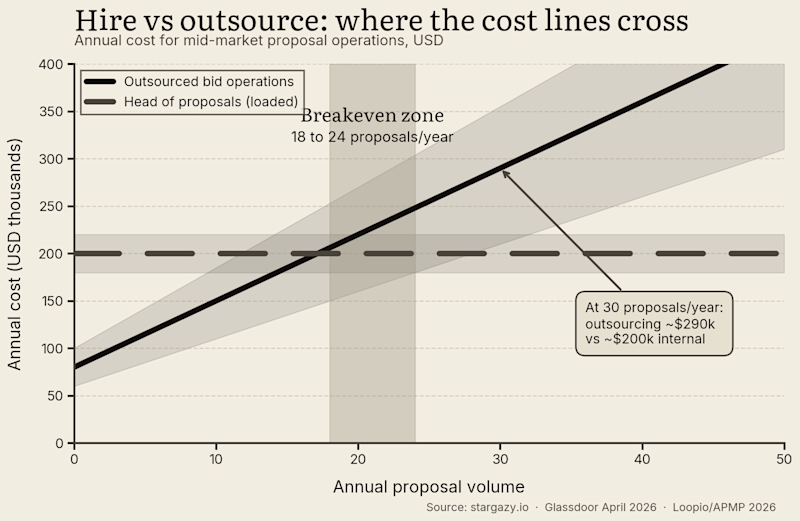
Above that volume, internal capability is cheaper before you count the compounding value. Below 12 proposals a year, outsourcing is cheaper in any model.
Most mid-market companies sit between 30 and 80 RFPs annually. By volume alone, the math favors hiring. The reason most companies still outsource is that they evaluate the first 12 months in isolation, when the breakeven only appears at month 14 to 18.
You gotta think somewhat long-term if you want to make revenue + save on outsourcing costs!
Can you have a hybrid proposal team model?
The pattern that works for mid-market revenue functions has two stages:
-
Stage one: Outsource the system build. A capable bid consultancy or managed services partner builds the operating system. That means they build you a bid qualification framework, compliance matrix built on your data, a content library or proposal brain structure, win/loss debrief cadence, and reporting the CRO gives a snuff about.
-
Stage two: Hire the operator to run it. The first six months for a new head of proposals are spent learning the company, the SMEs, the pipeline, and the historical win/loss data. If they inherit a working system, that ramp shortens to weeks rather than months. They direct production rather than invent process.
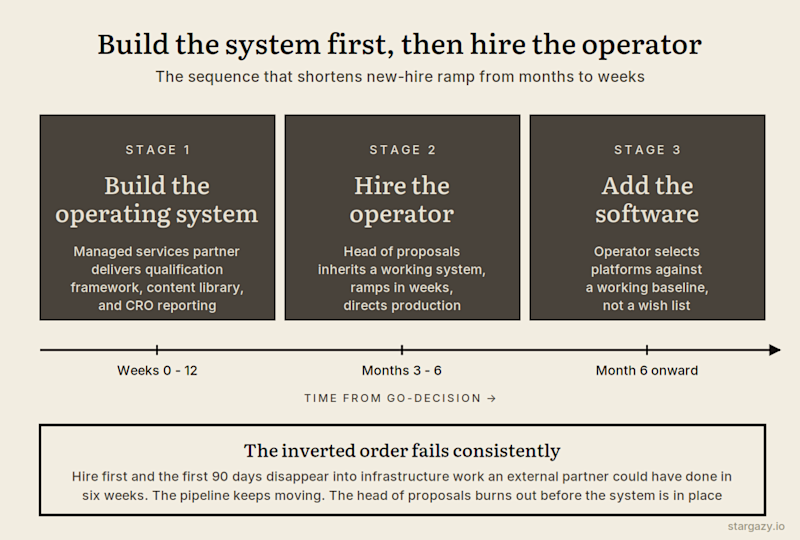
The mistake most companies make is to invert the order. They hire first, expecting the leader to build the system from a standing start. The first 90 days disappear into infrastructure work that an external partner could have completed in six weeks. The pipeline keeps moving, but your darling head of proposals burns out before the operating system is in place.
stargazy's analysis of mid-market proposal operations published in the 2026 Proposal & Bid Software Report shows the same pattern across enterprise SaaS, professional services, and AEC verticals. The Win Intelligence Assessment was built specifically to diagnose where revenue functions sit on this curve before they make the build or buy call.
Your worst idea is not hiring a proposal managed service OR team
Your Solution Consultant or sales rep can respond to the RFPs, obviously. Especially with AI? Right?
I mean, they can. But you are in the business of making revenue for the company, not wasting everyone's time.
Some mid-market companies pick a third option that looks reasonable, but financially speaking, it isn't. They buy proposal management software, designate a sales operations or revenue operations generalist to "own RFPs," and expect the tool to compensate for the absence of a dedicated leader.
This will not work as well as you think it well. Ever.
That choice fails consistently. Software accelerates a well-run process built by someone who knows what a winning processes and proposal output looks like. It does not invent one, no matter how lovely the plan your LLM spit out looks like.
A tool without an owner produces faster mediocre proposals that waste everyone's time, including your customers'.
Build the system before you hire the writer is the standing rule. The order matters because the operating system gets built externally, the head of proposals comes in to run it once it is working, and software gets layered in when there is an operator to direct it. In that order, the math works. In any other order, the next 18 months will cost you more than the math says they should.
✹
Frequently asked questions
When does it make sense to hire a head of proposals instead of outsourcing?
The breakeven sits at 18 to 24 proposals per year for most mid-market revenue functions. Above 24 medium-complexity proposals annually, internal hire is cheaper than outsourced equivalent capacity once you count loaded cost on both sides. Below 12 proposals a year, outsourcing is cheaper in any model.
What does a head of proposals cost in the US in 2026?
Glassdoor's April 2026 data puts the US median for a senior proposal manager at $130,812 and a director of proposals at $158,480. Fully loaded cost including benefits, payroll taxes, equipment, and training typically runs 25 to 35 percent above base. A mid-market head of proposals hire sits at $180,000 to $210,000 fully loaded.
What does outsourcing bid management cost monthly?
Fractional bid manager retainers from established proposal consultancies typically run $8,000 to $15,000 per month for around 25 hours of dedicated work. Senior practitioner day rates for surge pursuits run $1,500 to $2,500. Annual cost at mid-market volume of 24 proposals lands at $160,000 to $220,000 once library governance and coordination overhead are included.
Can proposal management software replace a head of proposals?
No. Software accelerates a well-run process. It does not create one. The 51 vendors in stargazy's 2026 Proposal & Bid Software Report each assume the buyer has someone in place to direct the platform with intent. A tool without an owner produces faster mediocre proposals rather than better outcomes.
What is the right order to build a proposal function?
Stage one: outsource the system build using a managed services partner over six to twelve weeks. Stage two: hire the head of proposals to run the system once it is working. Stage three: select software once the operator has identified what fits. Inverting this order is the most common reason mid-market proposal functions fail in year one.
How long before an internal hire pays off vs continued outsourcing?
For most mid-market companies submitting 24 to 30 proposals annually, the breakeven appears at month 14 to 18. Outsourcing looks cheaper in the first 12 months because hiring carries upfront recruiting and ramp costs. The compounding value of institutional knowledge, content library quality, and SME relationships only accrues to the permanent hire.
✹
Sources
-
Glassdoor. (April 2026). Senior Proposal Manager: Average Salary and Pay Trends 2026.
https://www.glassdoor.com/Salaries/senior-proposal-manager-salary-SRCH_KO0,23.htm
-
Glassdoor. (April 2026). Director of Proposals: Average Salary and Pay Trends 2026.
https://www.glassdoor.com/Salaries/director-of-proposals-salary-SRCH_KO0,21.htm
-
Glassdoor. (April 2026). Proposal Manager: Average Salary and Pay Trends 2026.
https://www.glassdoor.com/Salaries/proposal-manager-salary-SRCH_KO0,16.htm
-
OST Global Solutions. How do capture and proposal consultants charge for their services?
-
stargazy. (April 2026). 2026 Proposal and Bid Software Report.
-
Salary loaded cost ratios based on stargazy analysis of standard US employer overhead (benefits, payroll taxes, equipment, training) of 25 to 35 percent above base.

Christina Carter
I’m the founder of stargazy, the intelligence network for capture and proposal professionals. With 15+ years of running presales and proposal teams for B2B Enterprise, UK Public Sector, and US GovCon around the globe.