AI data governance for revenue and proposal teams: the risk you're ignoring

Published on April 9, 2026
Most proposal teams evaluating AI tools spend their first vendor call asking about hallucinations. Hallucination is real, and it produces bad answers. But it is also visible. A reviewer catches a fabricated statistic in draft, because their review process works.
Data governance failures are different. They happen outside the proposal team's line of sight, in the infrastructure layer where confidential content moves between systems. And by the time someone discovers the exposure, the data has already left the proverbial building.
Data governance in proposal technology refers to the controls that determine where RFP content is stored, processed, and transmitted when AI tools handle confidential bid data.
Perry Robinson, CEO of RocketDocs, made this argument on a recent episode of The Stargazy Brief. Robinson has a legal background and has spent years building proposal technology for financial services, healthcare, and life sciences teams. His position is direct - that regulated proposal teams are fixated on the wrong AI risk.
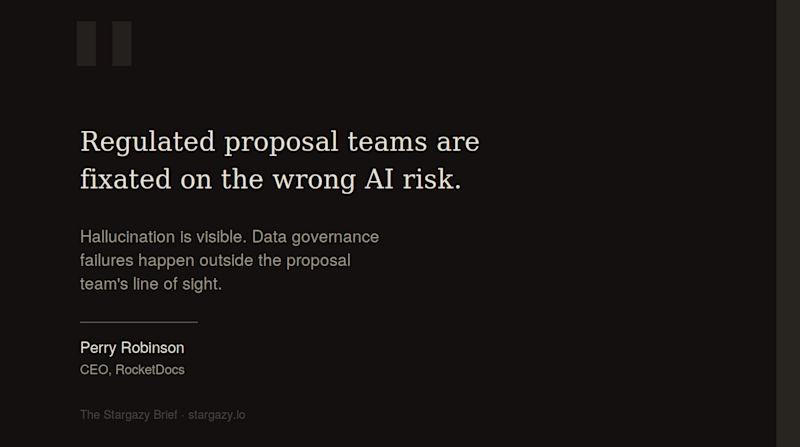
Where the real data governance exposure sits
The pattern Robinson described is one we are seeing across the proposal management software category, particularly among AI proposal tools that process regulated content. We call it the Three-Question Vendor Filter:
-
A proposal team adopts an AI tool.
-
The tool sends RFP content to a third-party language model provider for processing.
-
The proposal team never asked where that content goes, who stores it, or whether the AI vendor even owns the model infrastructure.
Robinson cited a multinational bank that had to remove an AI proposal tool mid-deployment because the bank's security team discovered that proposal content, including client-specific pricing and legal terms, was being passed through an uncontracted third-party AI provider. No one on the proposal team had flagged it because how could they have? and no one on the vendor's sales team had disclosed it.
That story is not unusual. Most AI proposal tools on the market today sit on top of third-party model providers. The proposal team sees a branded interface, but underneath, their data flows through infrastructure the vendor does not control.
Three AI vendor evaluation questions that cut the list fast
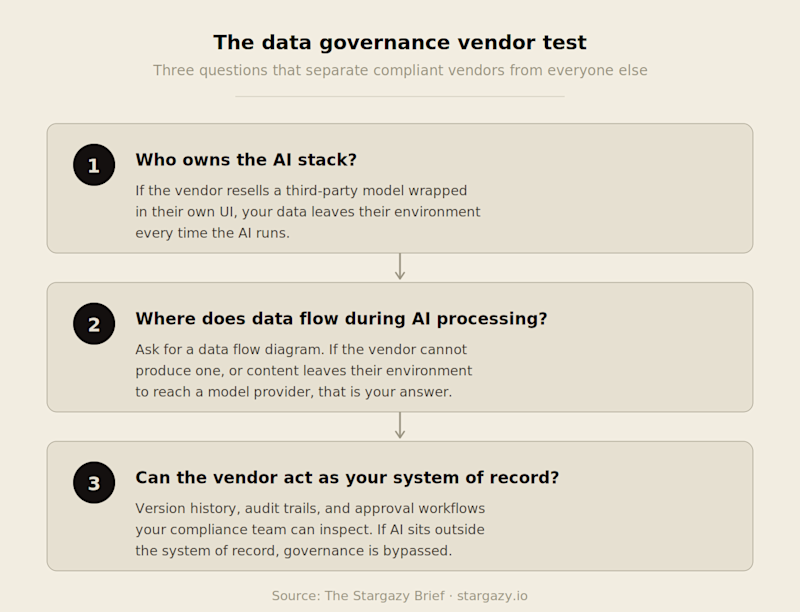
Robinson offered a vendor evaluation filter that any proposal leader in a regulated industry can apply immediately. Three questions, asked early in the sales process, that separate compliant vendors from everyone else.
-
First, who owns the AI stack? If the vendor is reselling a third-party model wrapped in their own UI, your data leaves their environment every time the AI runs. Ask whether the vendor owns, hosts, and controls the model infrastructure end to end.
-
Second, where does data flow during AI processing? Ask for a data flow diagram. If the vendor cannot produce one, or if the diagram shows content leaving their environment to reach a model provider, that is your answer.
-
Third, can the vendor act as your system of record? A system of record means version history, audit trails, and approval workflows that your compliance team can inspect. If the vendor's AI sits outside the system of record, generated content bypasses your governance controls entirely.
Robinson added that a system of record is only useful if it captures the full chain of custody. As a proposal management platform built on private AI infrastructure, proposal content stays within their environment, and the platform functions as the system of record for every generated response.
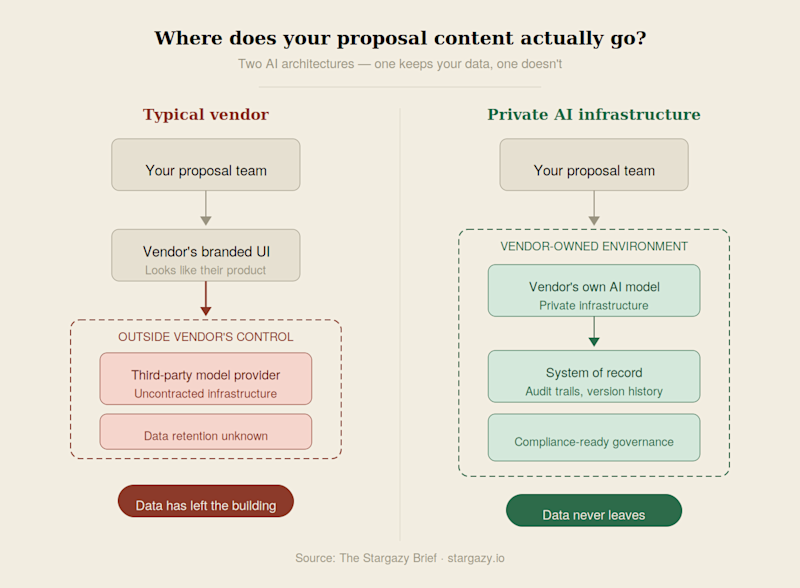
Yet most AI tools generate content outside the audit trail entirely, which means the compliance team is reviewing a final document with no visibility into how it got there.
That is the standard regulated teams should be holding every vendor to.
The career opportunity in AI governance for proposal professionals
Robinson made a second point worth flagging. Proposal managers who learn to ask these questions, and who can translate data governance risk into language a CISO or compliance officer understands, position themselves for AI governance committees. Those committees are forming across financial services and healthcare right now. But most of them have no one from the proposal function at the table.
Proposal teams in regulated industries should evaluate AI vendors on data governance before accuracy. The three critical questions are ownership of the AI stack, data flow during processing, and whether the tool serves as the system of record. Vendors that cannot answer all three affirmatively introduce compliance risk that no hallucination filter can fix.
The proposal team handles some of the most sensitive content in any organization, like pricing, legal terms, client-specific commitments, competitive positioning. If AI touches that content, the proposal function should have a voice in how it is governed. The professionals who step into that role now will define it.
All information in this blog was was inspired directly by Perry Robinson, CEO of RocketDocs. Listen to the full conversation on The Stargazy Brief.

Christina Carter
I’m the founder of stargazy, the intelligence network for capture and proposal professionals. With 15+ years of running presales and proposal teams for B2B Enterprise, UK Public Sector, and US GovCon around the globe.