How to evaluate AI proposal software in 2026

Published on March 17, 2026
Most revenue leaders buying proposal software in 2026 are chasing the wrong variable.
The assumption behind most evaluations runs something like this: AI-powered tools write faster, faster writing means more proposals submitted, more proposals mean more revenue. Stargazy's 2026 Proposal Win Rate Report with AutoRFP.ai tested that assumption directly. The result was AI tool adoption shows zero independent correlation with proposal win rates once structural and process variables are controlled (Spearman ρ = 0.00, p = 0.98).
The variable that does predict win rates is revenue dependence on competitive bids (ρ = 0.40, p < 0.001). Teams whose pipeline depends on winning proposals invest more in the operating infrastructure around those proposals, from formal go/no-go discipline, dedicated bid roles, systematic capture routines, and governance controls. AI amplifies whatever operating model already exists. If the model is disciplined, AI compounds the advantage. If the model is fragmented, AI compounds the mess.
A CRO approving a six-figure proposal technology purchase faces a real risk of buying a tool that increases draft output while leaving the actual win-rate drivers untouched.
✹
The buying error almost every team makes
The most common evaluation error runs deeper than picking the wrong vendor. Teams compare platforms that solve different problems because they evaluate by feature grid instead of by architectural fit.
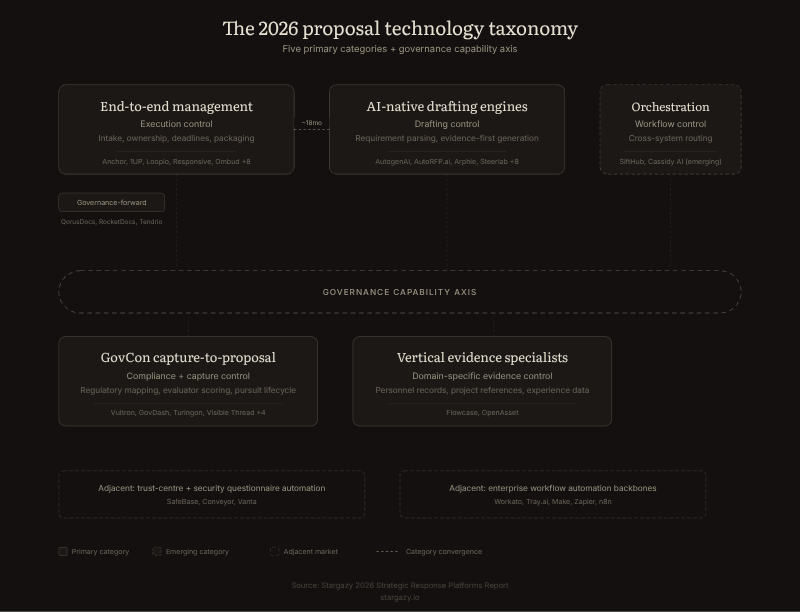
Proposal technology in 2026 separates into five architectural categories, each built to remove a different operational constraint:
-
End-to-end management platforms enforce submission discipline: intake, ownership, deadlines, stage-gated reviews.
-
AI-native drafting engines generate first-draft responses from governed sources at the moment of use.
-
Workflow orchestration platforms coordinate routing and approval enforcement across multiple systems.
-
GovCon capture-to-proposal platforms map regulatory compliance and evaluator-scoring logic into the proposal itself.
-
Vertical evidence specialists manage structured personnel records and project references for industries where experience credentials determine evaluation scores.
A sixth dimension, governance, cuts across all five. Governance is the enforcement of approval states, permissions, auditable claim lineage, and content freshness. Every category must be scored against governance maturity.
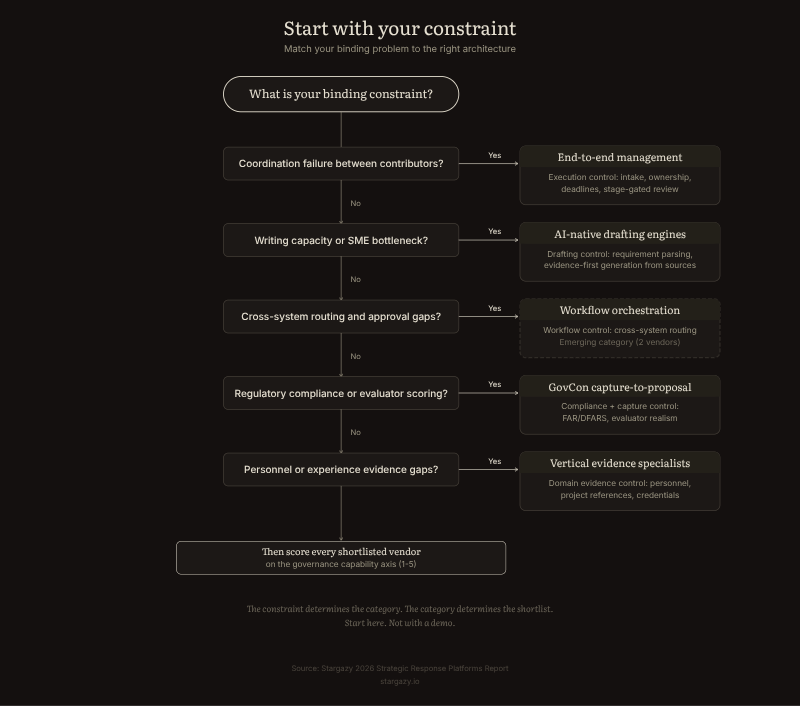
The buying error happens when teams misdiagnose their constraint. A 30-person sales department losing bids due to coordination breakdown between contributors buys a drafting engine because the demo was fast. The drafting engine produces more text, but the coordination problem persists. Reviewers get buried under AI-generated content they did not request and cannot verify. Off-platform work rates stay the same or climb. The tool gets blamed. The constraint was never addressed.
The most common buying error: purchasing a drafting engine to solve a coordination or governance problem. The second most common: treating a general-purpose automation tool as proposal technology.
The second most common error is treating a general-purpose automation backbone (Zapier, Make, Workato) as proposal technology. These tools can be configured for proposal workflows, but they lack proposal-context awareness. They do not understand requirements, claims, approval states, or submission deadlines. Including them in a proposal evaluation is like including Slack in a project management assessment because teams coordinate projects there.
✹
Trust fidelity is your hidden pipeline risk
The performance standard that separates tools which reduce total work from tools that relocate work has a name: trust fidelity. Trust fidelity is the system's ability to generate, reuse, and approve claims that are grounded in identifiable source material, constrained by permissions, and traceable to accountable reviewers.
When trust fidelity is low, AI increases draft volume without reducing the validation burden on subject matter experts. Reviewers spend their time rewriting AI-generated text instead of confirming it. Cycle times stagnate or worsen even as drafting speed metrics improve. The CRO sees a dashboard showing faster first drafts. The Head of Proposals sees reviewers staying late and reverting to email.
McKinsey's 2025 survey adds the wider context. 51% of organizations using AI report at least one negative consequence, and inaccuracy is the most commonly reported risk. For a revenue leader, trust fidelity translates directly into pipeline risk. A proposal platform that produces fluent, confident text without claim-level evidence creates an audit trail of unverified assertions. In regulated industries, those assertions carry legal weight. In competitive evaluations, they carry scoring weight. When an evaluator traces a capability claim back to nothing, the bid loses credibility no revision cycle can recover.
✹
Five questions to ask before you sign
These are designed for the person who approves the purchase order, not the person who runs the pilot.
1. What does the system do when evidence is weak?
Ask the vendor to demonstrate what happens when the platform receives a question for which no authoritative source exists. If it generates a confident answer anyway, that is a governance risk you carry into every submission. The stronger standard is the system flags uncertainty, refuses to produce an unsupported claim, or routes the question to a named subject matter expert.
2. Name the first workflow you will replace in 90 days.
If the vendor cannot name the exact workflow, with the exact users, data sources, and success criteria, they are selling aspiration. A good answer is, "We will replace your DDQ drafting process for the security team, using your existing SharePoint compliance library, and you will measure reviewer override rate weekly." A bad answeris, "We integrate across your entire proposal operation."
3. What happens to review hours, not drafting hours?
Top-performing teams still spend more time than average on proposals, regardless of AI or software use. They spend that time on review and competitive differentiation rather than first-draft composition. If a tool reduces drafting hours but increases review hours, total effort has not decreased. Ask the vendor how they measure and reduce reviewer burden specifically.
4. How does the platform handle permissions when it retrieves from our existing systems?
When the tool pulls content from SharePoint, Google Drive, Confluence, or a CRM, does it respect the source system's access controls? Or does the platform's service account bypass those controls, giving every user access to every indexed document? Permission inheritance is the most common governance failure in proposal technology, and the hardest to test in a demo. Require the vendor's permission model documentation and test it with a restricted user during pilot.
5. What does your system look like when the contract is 18 months old and the original admin has left?
AI proposal tools decay when the people who set them up move on. Content ownership goes stale. Permissions drift. Review gates get bypassed under deadline pressure. Ask the vendor what the minimum viable staffing model is to maintain the platform in production. If the answer requires more administrative overhead than your team can sustain, the tool will become shelfware before the first renewal.
✹
What good looks like in the first 90 days
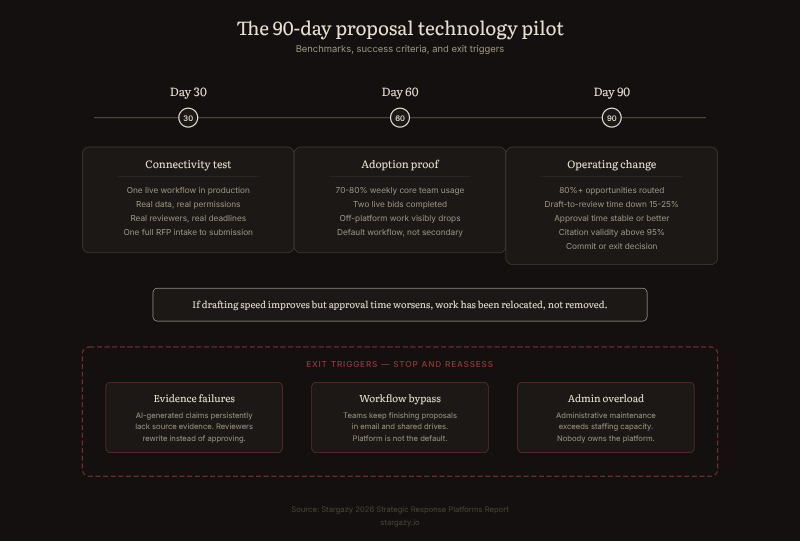
By day 30, you should have one live workflow running in production with real data, real permissions, and real reviewers. One live workflow means one actual RFP or DDQ completed inside the system from intake through final submission, with actual contributors and deadlines. If this has not happened by day 30, the rollout is still in setup mode.
By day 60, a healthy rollout shows 70 to 80 percent weekly usage among the core proposal team, at least two live bids completed in the new process, and a visible reduction in off-platform coordination. If teams are still finishing proposals in email and shared drives at this point, the platform is not the default workflow.
If drafting speed improves but approval time worsens, work has been relocated, not removed.
By day 90, three conditions should hold. First, 80 percent or more of in-scope opportunities are routed through the system. Second, draft-to-review-ready time has dropped 15 to 25 percent. Third, final approval time has stayed stable or improved. If drafting speed improves but approval time worsens, work has been relocated, not removed.
Define exit triggers before the pilot starts. Persistent evidence failures, workflow bypass rates above your threshold, and administrative load exceeding staffing capacity are all signals to stop and reassess rather than commit to a multi-year contract.
Gartner predicted that at least 30% of generative AI projects would be abandoned after proof of concept by the end of 2025 due to data quality problems, weak controls, unclear value, or rising costs. Proposal technology is no exception. The teams that run disciplined pilots with defined success criteria make better purchasing decisions. The teams that buy from demos do not.
✹
What to do next
This article gives you the framework. The full 2026 Strategic Response Platforms Report (coming in April) gives you the taxonomy (five categories, a governance capability axis, two adjacent markets), the vendor landscape (40+ legitimate proposal platforms mapped by architecture, buyer archetype, and industry), and the buying tools.
Start with your constraint. Use the Stargazy Constraint Classifier (coming in April) to identify which architecture removes it. Download the 90-Day Pilot Framework (coming in April) to structure your evaluation with the metrics that predict adoption. If you need the revenue case for your board, the Revenue Impact Brief (coming in April) translates this analysis into win-rate, pipeline-velocity, and cost-of-inaction terms.
The decision is all about the architecture that removes the constraint that is costing you deals.
✹
FAQ Section
Q: Does AI proposal software actually improve win rates?
A: Stargazy's 2026 Proposal Win Rate Report found zero independent correlation between AI tool adoption and win rates once structural variables are controlled (ρ = 0.00, p = 0.98). Win rates are predicted by revenue dependence on competitive bids, formal go/no-go discipline, and dedicated bid roles. AI amplifies the existing operating model.
Q: What is trust fidelity in proposal technology?
A: Trust fidelity is the system's ability to produce claims grounded in identifiable sources, constrained by permissions, and traceable to accountable reviewers. Low trust fidelity means AI-generated drafts increase reviewer workload instead of reducing it.
Q: What is the most common mistake when buying proposal software?
A: Purchasing a platform that solves the wrong constraint. Teams misdiagnose their binding problem, typically buying a drafting engine to solve a coordination or governance problem, then wonder why adoption stalls.
Q: How should I structure a proposal software pilot?
A: Run one real RFP through the system in the first 30 days with real contributors and deadlines. By day 60, target 70-80% weekly usage. By day 90, measure whether draft-to-review time dropped 15-25% and whether approval time held steady. If drafting speed improved but approval time worsened, the tool relocated work instead of removing it.
Q: What questions should a CRO ask proposal software vendors?
A: These five questions matter most: What does the system do when evidence is weak? Name the first workflow you will replace in 90 days. What happens to review hours? How does the platform handle permissions across integrations? What does the system need to stay healthy 18 months after setup?

Christina Carter
I’m the founder of stargazy, the intelligence network for capture and proposal professionals. With 15+ years of running presales and proposal teams for B2B Enterprise, UK Public Sector, and US GovCon around the globe.