Your Bid Protest Readiness Starts Before You Lose

Published on March 18, 2026
Most federal proposal teams treat bid protests reactively. They lose, they panic, they call a lawyer. The timelines for filing at GAO are 5 to 10 days, leaving almost no room to build a case from scratch. In 2026, GAO's tightened pleading standard makes speculative protests even riskier. The teams that protest effectively are the ones that prepared before they lost. This article lays out the internal processes proposal managers need to build now.
A bid protest is a legal challenge to the award or terms of a federal contract. Protests can be filed at three forums: the contracting agency, GAO, or the Court of Federal Claims. Pre-bid protests challenge solicitation terms before award. Post-award protests challenge evaluation decisions after contract award.
The assumption that no longer holds
Federal proposal teams have long treated bid protests as a post-loss activity. Someone loses, gets upset, and the question becomes: should we protest? The answer is typically no. David Timm, a partner at Bernd Foreman who chairs the Federal Bar Association's Bid Protest Committee, estimates that eight or nine times out of 10, he tells contractors to save their money for the next pursuit.
That statistic isn't a reason to ignore protests. It's a reason to change when and how you prepare for them.
Why reactive protest decisions fail
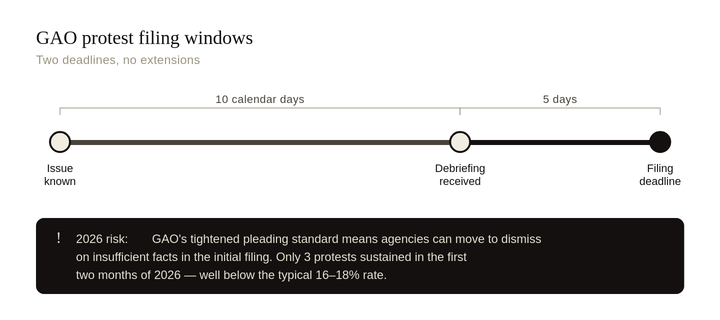
The structural problem is timing. At GAO, you have 10 days from when you knew or should have known about the issue, or 5 days after a debriefing, to file. That is not enough time to assess the merits of a protest, choose the right forum, and assemble a filing, unless your team has done pre-work.
GAO's July 2025 pleading standard clarification makes this worse. The standard wasn't merely clarified. It was tightened. Agencies can now move to dismiss based on insufficient facts in the initial filing. If your protest relies on information that only exists in the administrative record, which you receive after a dismissal request is resolved, you may never get to it. You lose before you start.
The evidence: three sustained protests in the first two months of 2026. That is significantly below the typical 16 to 18% sustain rate.
What pre-loss protest readiness looks like
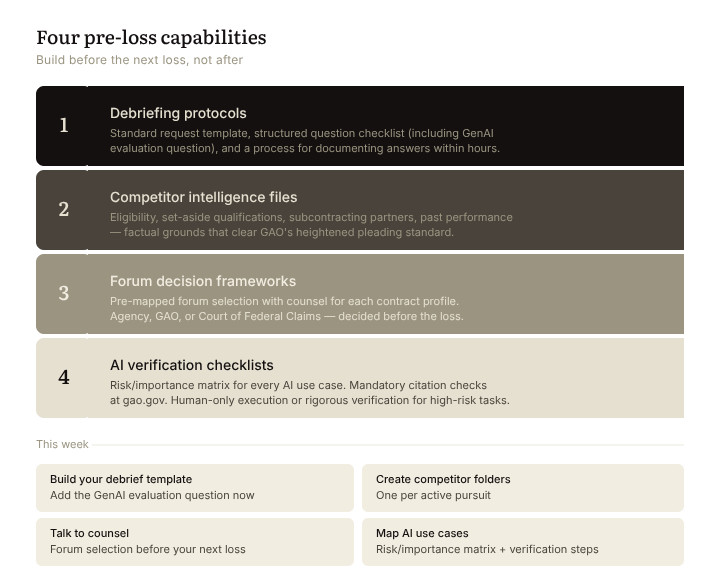
Proposal managers can build four capabilities before the next loss.
Debriefing protocols. The Department of Defense offers enhanced debriefings that are more detailed than what other agencies provide under the FAR. Every team should have a standard debriefing request template, a checklist of questions to ask (including, now, whether GenAI was used in evaluation), and a process for documenting answers within hours of receipt. The debriefing is your primary intelligence source for determining whether a protest has merit.
Competitor intelligence files. David Timm's advice is worth paying attention to here. Knowing your competitors, their eligibility for set-asides, their likely subcontracting partners, and their past performance record gives you factual grounds for protest that get past GAO's heightened pleading standard. A protest grounded in "we know the awardee doesn't qualify as a small business" is a factual argument. A protest grounded in "we thought our proposal was better" is ego.
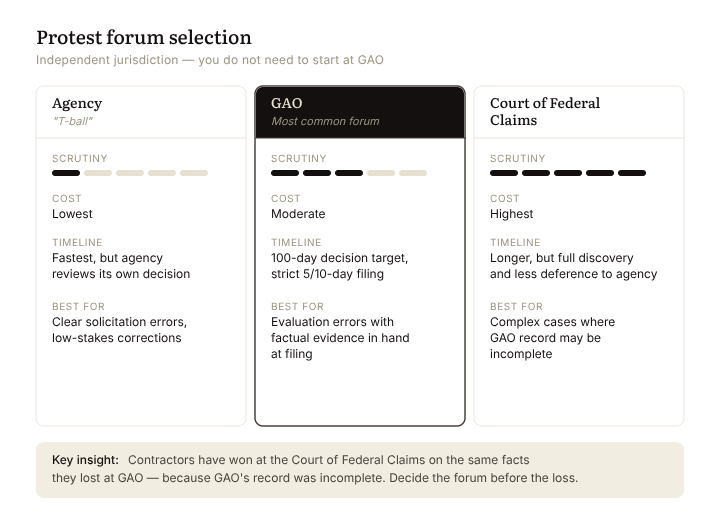
Forum decision frameworks. The three protest forums operate at different levels of scrutiny. The agency itself has the lowest bar (Timm calls it T-ball). GAO is the middle ground but has strict timelines and a newly tightened standard. The Court of Federal Claims provides the most thorough review and is less deferential to agency decisions, but costs more. Timm has documented cases where contractors lost at GAO and won at the Court of Federal Claims on the same facts, because GAO's record was incomplete. Proposal managers should work with counsel before a loss to understand which forum fits their typical contract profile.
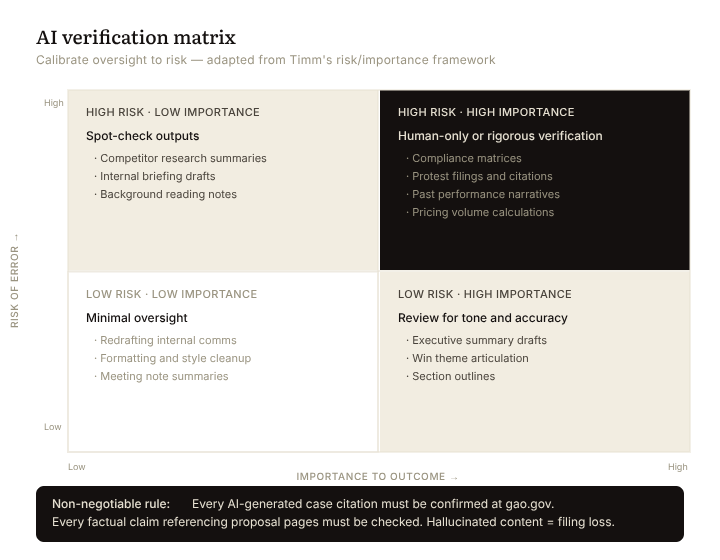
AI verification checklists. If your team uses LLMs in any part of the proposal or protest process, you need a verification protocol calibrated to risk. Timm's risk/importance matrix is a practical starting point. Low risk, low importance tasks (redrafting internal communications) need minimal oversight. High risk, high importance tasks (drafting compliance matrices, writing protest filings) need either human-only execution or rigorous verification. Every AI-generated case citation must be confirmed at gao.gov. Every factual claim referencing specific proposal pages must be checked against the actual document. Timm has documented cases where AI fabricated page references that didn't exist, and every filing with hallucinated content ended in a loss.
The GenAI evaluation question
There is a new item for your debriefing checklist. Ask whether the agency used generative AI tools in evaluating bids. The FAR requires independent judgment in bid evaluation. If the government used an LLM to produce a full evaluation, that is likely protestable because the work cannot be shown and the reasoning cannot be independently verified. If they used it for summarization before conducting their own evaluation, that is probably acceptable.
The boundary between those two extremes is legally undefined. No precedent exists yet. But the question itself puts the issue on record and could surface facts that support a later protest.
What this changes for Monday morning
Build your debriefing request template this week. Add the GenAI evaluation question. Create a competitor intelligence folder for each active pursuit. Talk to counsel about forum selection before your next loss, not after. If your team uses AI for proposal drafting, map every use case onto the risk/importance matrix and build verification steps for anything in the high-risk quadrant.
Protest readiness is a process capability. The teams that win protests are the ones who treated them as a possibility before they became a necessity.
Go deeper on this. We cover bid protest strategy, AI governance in regulated proposals, and the operational decisions that separate winning teams from reactive ones on The Stargazy Brief. If this article was useful, the podcast is where we unpack these topics with the people shaping them.
✹
FAQ Section:
Q: How long do I have to file a bid protest at GAO?
A: 10 days from when you knew or should have known about the issue, or 5 days after a debriefing.
Q: Can I skip GAO and file directly at the Court of Federal Claims?
A: Yes. The forums have independent jurisdiction. You do not need to start at GAO.
Q: Does protesting damage my relationship with a federal agency?
A: Evidence suggests contractors who protest on legitimate grounds continue winning future work. Agencies have many contracting officers and high turnover.
Q: Should I ask if GenAI was used in bid evaluation?
A: Yes. The FAR requires independent judgment. Documenting whether AI was used could support a future protest.
✹
Get intelligence like this weekly. The Stargazy Brief delivers proposal technology analysis, procurement policy shifts, and operational strategy for revenue teams. Subscribe →
Follow David Timm on LinkedIn to keep up to date on the latest bid protest news.

Christina Carter
I’m the founder of stargazy, the intelligence network for capture and proposal professionals. With 15+ years of running presales and proposal teams for B2B Enterprise, UK Public Sector, and US GovCon around the globe.