The best capture and proposal software for GovCon in 2026 ✹ An independent comparison

Published on September 23, 2026
Ten platforms now compete for federal contractors' proposal budgets.
By Christina Carter, founder, stargazy | Independent analysis | Security statuses checked September 2026
For US federal contractors in 2026, the strongest capture and proposal platforms are GovDash, Procurement Sciences, GovSignals, Unanet and Deltek GovWin IQ. What should separate them in a buying decision is verifiable security posture, meaning what the FedRAMP Marketplace records, rather than the quality of their AI drafting.
That distinction is harder to see than it should be. Vendors describe their security in at least six ways, from "authorized" to "equivalent" to "ready." The rankings that dominate search results are written almost entirely by vendors, each of which puts itself first. This analysis checks those claims against the public record. It draws on stargazy's evaluation of the proposal and bid software market in the 2026 Proposal & Bid Software Report, and on its research into why teams win and lose competitive RFPs across more than 1,000 organizations.
What changed in GovCon proposal software in 2025 and 2026?
The market consolidated quickly. Venture money and acquisitions pulled a crowded field of start-ups toward a handful of platforms that cover the whole cycle, from finding an opportunity to submitting the proposal.
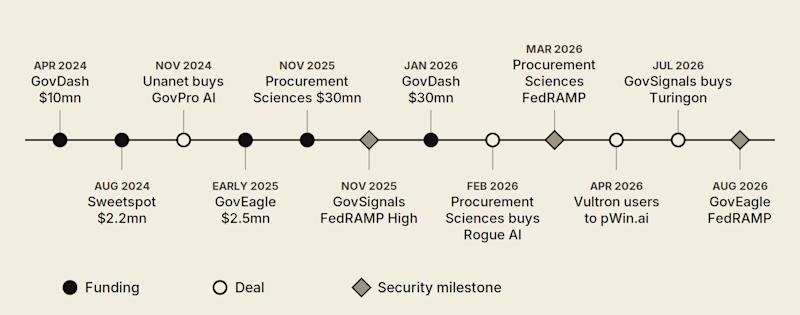
Procurement Sciences, maker of Awarded AI, raised a $30mn Series B in November 2025 led by Catalyst Investors, then bought Rogue AI in February. GovDash raised its own $30mn Series B in January, led by Mucker Capital and BCI. In April, Vultron, which had claimed more than 400 federal contractor customers, directed its entire user base to pWin.ai. Two months earlier pWin.ai had signed a resale and integration deal with TechnoMile. GovSignals bought Turingon in July.
The incumbents moved too. Unanet bought GovPro AI, now ProposalAI, and Contraqer, now GovIntel. Deltek announced AI proposal generation for GovWin IQ and Costpoint. The result for buyers is fewer, larger vendors, and more pressure to buy a whole platform rather than a point tool.
What is the difference between capture management and proposal management software?
Capture management software helps a contractor decide which opportunities to pursue and how to position for them before a solicitation is released. Proposal management software helps the team respond once it is. Capture covers discovery, qualification, pipeline tracking, competitor and incumbent research, and teaming. Proposal work covers breaking the solicitation down (known as shredding it) into a compliance matrix, then outlining, drafting, color team review and production.
The two used to be bought separately. Most of the platforms below now sell both, on the reasoning that intelligence gathered during capture should feed straight into the proposal. Whether one vendor does both well is a separate question, and one buyers should test rather than assume.
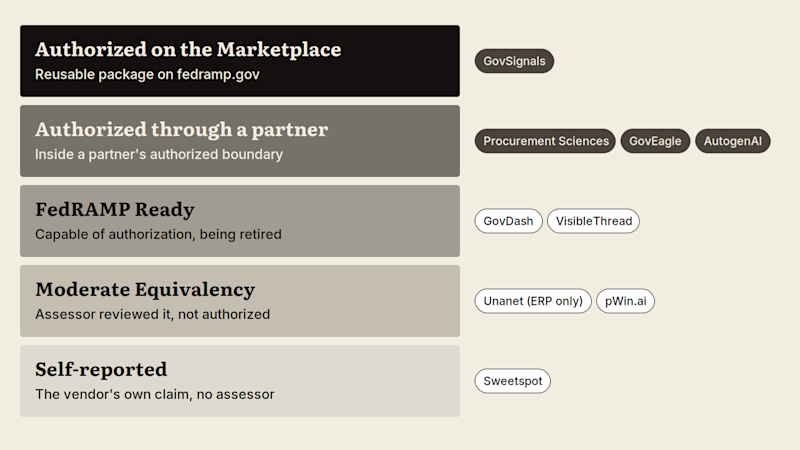
GovSignals holds the strongest verifiable position. In November 2025 it announced a FedRAMP High listing on the Marketplace, and a competitor reports that it also holds DoD IL5 through Second Front's Game Warden.
Three vendors reached authorization through a partner. Procurement Sciences announced FedRAMP authorization through Knox Systems in March 2026, and GovEagle announced FedRAMP Moderate authorization through Knox in August. AutogenAI markets FedRAMP High through Palantir's FedStart program, an inherited authorization that was not separately listed as of July 2026. In each case, the buyer should ask which security controls remain its own responsibility.
GovDash and VisibleThread both sit at Legacy FedRAMP Ready. GovDash's Marketplace entry, package FR2617333263, shows Class C with zero authorizations. VisibleThread joined the Marketplace in July 2026 and says its CMMC Level 2 assessment is in process.
The rest rely on weaker claims. Unanet's Moderate Equivalency covers its ERP, while its CRM and ProposalAI remain on the 2026 compliance roadmap, and pWin.ai's Moderate Equivalency is stated by the vendor. Sweetspot reports CMMC Level 2 and SOC 2 Type II itself, without independent confirmation. We found no FedRAMP authorization for Deltek's proposal AI.
What should federal contractors check before buying?
Check security first, because it determines whether the tool can be used on the pursuits that matter. The remaining criteria sort platforms by fit.
-
Security and compliance. Check FedRAMP Marketplace status and package ID, impact level, and DoD IL4 or IL5. Check hosting in GovCloud or GCC High, NIST SP 800-171 alignment, and the vendor's own CMMC Level 2 status. Check SOC 2 Type II, ITAR support, zero data retention, and a contractual commitment not to train models on customer data.
-
Opportunity data. Look for coverage of SAM.gov, including its new API, GovWin, HigherGov, GovTribe, GSA eBuy, DIBBS, and state and local portals.
-
Capture. Look for pipeline and CRM, bid and no-bid scoring, competitor and incumbent intelligence, call plans, and teaming partner management.
-
Proposal execution. Look for shredding of Sections L, M and C, annotated outlines, and amendment tracking. Look for drafting grounded in your own content with citations, Office add-ins, color team workflows, and alignment with Shipley or APMP practice.
-
Content. Look for libraries for past performance, résumés, key personnel and approved boilerplate.
-
Integrations. Look for connections to Salesforce, HubSpot, Unanet CRM, Deltek Costpoint and GovWin, and SharePoint.
-
Commercials. Compare seat versus platform pricing, implementation time, and auto-renewal terms.
-
Proof. Ask for references at your size, measured reductions in cycle time, and win-rate change against a baseline.
What does FedRAMP status mean for proposal AI?
Only a FedRAMP authorization recorded on the Marketplace means an agency-reusable security package exists. "Moderate Equivalency" means an independent assessor has reviewed a system against the Moderate baseline. That is useful evidence, but it is not an authorization. "Ready" means an assessor judged the vendor capable of achieving one.
The vocabulary is also, like most things in GovCon right now, changing. Under FedRAMP's consolidated rules for 2026, the Ready designation is being retired in favor of a single FedRAMP Certified designation in Classes A to D. Since July, providers in initial implementation can appear on the Marketplace before they are certified. A listing alone no longer proves authorization.
This matters for proposals because of controlled unclassified information (CUI). Public solicitations can generally be processed in enterprise-grade AI tools. Non-public bid information, source selection information and CUI fall under the Procurement Integrity Act ([FAR 3.104](LINK TBC)), DFARS 252.204-7012 and NIST SP 800-171, and do not belong in consumer AI.
GovSignals even described it as, "If it is not FedRAMP High for CUI, do not upload it." That is one vendor's position rather than a regulation, but it is still the question a compliance officer will ask.Third-party content muddies this further. GovDash states on its own site that it is FedRAMP Ready and not yet authorized, which is to its credit. A competitor's ranking says GovDash already holds the audit, and another describes it as FedRAMP Moderate on AWS GovCloud, while GovDash's own material says Azure. Buyers should read vendor comparison pages the way they read a rival's past performance volume.
Which capture and proposal platforms lead GovCon in 2026?
The ten platforms below were chosen on four tests:
-
They are built for, or heavily used by, US federal contractors.
-
They cover at least two of discovery, capture and proposal execution, or set the standard for one of them.
-
They show momentum or a large installed base in 2025 and 2026.
-
They document their security posture.
Five of the ten cover the whole cycle, from opportunity discovery through capture, compliance matrix and AI drafting, in one product. GovDash and Procurement Sciences suit small and mid-tier contractors, and Unanet makes most sense for firms already running its ERP. GovEagle works inside Microsoft Word and builds the Section L and M matrix in Excel. Sweetspot is the cheapest option by a wide margin, at $720 to $3,600 a year.
Two platforms lead with intelligence rather than writing. Deltek GovWin IQ remains the benchmark for discovery and pipeline tracking, with compliance matrices rolling out and AI drafting still on its roadmap, at $13,000 to $119,000 a year. GovSignals starts earlier, with pre-RFP signals, and adds pipeline tracking, shredding and drafting for defense contractors.
Three are built for large prime proposal centers. AutogenAI's core strength is drafting, with capture planning and limited discovery. VisibleThread specializes in deterministic compliance checking and has recently added opportunity search and a kanban board. pWin.ai produces full-length drafts and gets its discovery and capture from TechnoMile's Growth Suite.
Pricing is mostly private. Only GovWin IQ, through Vendr's data on 2025 purchases, and Sweetspot have public figures. VisibleThread charges per user each year, and the rest require a sales conversation.
Which platform fits which contractor?
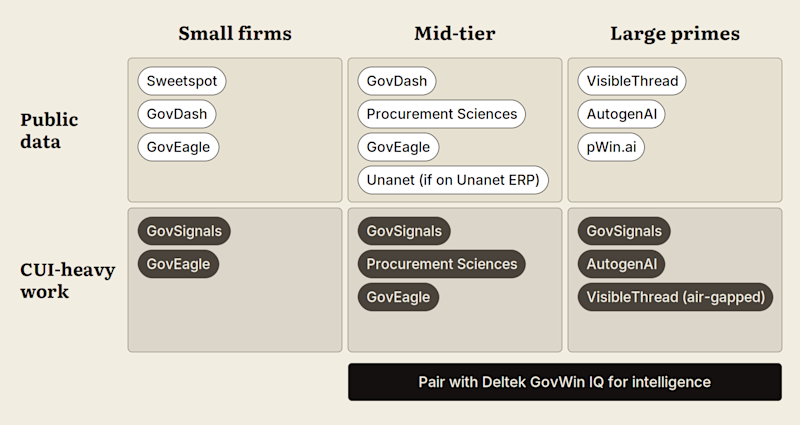
The right choice depends more on company size and the kind of work than on any single feature.
-
Small businesses and 8(a), SDVOSB, WOSB and HUBZone firms.
Sweetspot for price, and GovDash for breadth.
-
Mid-tier contractors.
GovDash or Procurement Sciences, or Unanet if the firm already runs its ERP.
-
Large prime proposal centers.
VisibleThread for compliance checking, AutogenAI or pWin.ai for drafting at scale, and GovEagle for library-driven volume, usually alongside GovWin IQ for intelligence.
-
Defense work involving CUI.
GovSignals first, then AutogenAI.
How do the ten platforms compare in detail?
GovDash, best all-in-one platform for small and mid-tier contractors
GovDash covers opportunity discovery across SAM.gov, GSA eBuy and state and local portals. It adds a government CRM for capture, proposal drafting with compliance tracking and a Word add-in, and post-award contract management. The company says it serves nearly 200 companies and that its customers won more than $5bn in contract awards in 2025. Named customers include Scale AI, Threat Tec and Sumaria Systems. It holds a Moderate Equivalency assessment from January 2026 and a Legacy FedRAMP Ready listing with no authorizations, and has just one review on G2.
Deltek GovWin IQ, best for market intelligence and early positioning
GovWin IQ's advantage is its research operation, more than 150 analysts tracking forecasts, recompetes and pre-RFP activity.
Deltek added the Ask Dela assistant and AI proposal outlines in 2025 and planned full AI proposal creation inside GovWin IQ for early 2026. It is also the most expensive tool here.
Vendr data on 2025 purchases puts contracts between $13,000 and $119,000 a year, averaging about $29,000, with 60 days' notice needed to stop auto-renewal.
Unanet, best for contractors already running Unanet ERP
Unanet built its proposal suite through acquisitions:
-
ProposalAI, from the 2024 purchase of GovPro AI, claims first drafts up to 70 percent faster.
-
OpportuneAI adds go and no-go analysis inside Unanet CRM.
-
GovIntel adds market intelligence.
-
GrowthStudio, launched in early 2026, packages the tools for smaller firms.
The catch is coverage. Its Moderate Equivalency applies to the ERP, while CRM, GrowthStudio and ProposalAI remain on the compliance roadmap.
Procurement Sciences, best AI-native platform across federal, state and grants
Awarded AI handles opportunity matching, drafting, compliance review and contract execution for more than 300 organizations, including aerospace and defense firms. The November Series B and February purchase of Rogue AI make it one of the best-funded AI-native vendors. Rogue brought a writing assistant run in a NIST SP 800-171 environment. In March 2026 it announced FedRAMP authorization delivered through Knox Systems, a federal AI-managed cloud provider. Buyers should confirm it on fedramp.gov like the others.
GovSignals, best for defense contractors working with CUI
GovSignals is the only proposal AI vendor we found that has announced a FedRAMP High listing, in November 2025. It also reports DoD IL5 through Second Front's Game Warden. Its strength sits early in the cycle, monitoring Congress, budget documents, the Federal Register and GAO protest decisions for pre-RFP signals, alongside shredding and drafting. Competitors describe its drafting as secondary to its research, a claim worth testing in a pilot.
AutogenAI Federal, best for large enterprises focused on writing quality
AutogenAI, which started in the UK, concentrates on generating and scoring proposal text. It drafts across multiple models and checks compliance with a review tool called Gamma Review. It markets FedRAMP High through Palantir's FedStart program, so buyers should request the customer responsibility matrix. Discovery is limited, so it is usually paired with an intelligence tool.
VisibleThread, best for compliance checking at large prime proposal centers
Founded in 2008, VisibleThread uses deterministic extraction rather than generative AI to trace requirements, which makes its output easier to audit. It deploys in commercial cloud, GovCloud and GCC High, on premises, and in air-gapped or SCIF environments. Its July 2026 Marketplace listing is reported as Legacy Ready, and its CMMC Level 2 assessment is in process.
pWin.ai, best for Shipley-disciplined teams that want full drafts
pWin.ai was co-developed with Shipley Associates and produces complete first drafts from a library of past proposals and past performance. Its February partnership with TechnoMile adds discovery and capture through TechnoMile's Growth Suite, and in April it took on Vultron's user base. Its security claim, Moderate Equivalency, comes from the vendor.
GovEagle, best Word-native platform with a FedRAMP Moderate authorization
GovEagle, founded in 2022, shreds a solicitation into a Section L and M compliance matrix in Excel. It then builds an annotated Word outline before any drafting begins, and drafts from past proposals and past performance. A PowerPoint integration carries the same material into oral presentation decks, which federal buyers increasingly request. In August 2026 it announced FedRAMP Moderate Authorization through Knox Systems, the same route Procurement Sciences took. Its funding is modest, $2.5mn from Y Combinator and Strategic Cyber Ventures, and it has few public reviews and no named customers.
Sweetspot, best value for small and set-aside businesses
Sweetspot searches SAM.gov, FPDS, USAspending, DIBBS, Grants.gov and more than 1,000 state and local portals, then produces bid briefs, compliance matrices and drafts. Its 2024 pricing, $720 a year for search and $3,600 for the full suite, is the lowest here by a wide margin. The Y Combinator company says it serves more than 500 GovCon teams. Its CMMC Level 2 and SOC 2 Type II claims are self-reported.
How much does GovCon capture and proposal software cost?
Most AI-native platforms do not publish prices, so buyers negotiate blind. The public data points below give a rough range.
Most AI-native platforms do not publish prices, so buyers negotiate largely blind. The few public data points give a rough sense of the range.
GovWin IQ sits at the top. Vendr's transaction data puts contracts between $13,000 and $119,000 a year, with an average of about $29,000. Auto-renewal needs 60 days' written notice to stop, a clause worth diarizing on the day the contract is signed.
The cheaper end belongs to intelligence tools and small-business platforms. HigherGov is reported at $500 to $5,000 a year and GovTribe at $1,350 to $5,500, though neither drafts proposals. Sweetspot's 2024 pricing, $720 a year for search and $3,600 for the full suite, makes it the least expensive option that also writes.
For GovDash, Procurement Sciences, GovSignals, GovEagle, Unanet, AutogenAI and pWin.ai, the price arrives only after a sales conversation. Read the renewal clause before the feature list.
Does the software you choose change your win rate?
Software mostly speeds up the middle of a pursuit. Contracts are more often won or lost at either end, in the positioning done before a solicitation appears and in what a team learns after the decision.
A platform that cuts a draft from three weeks to three days is valuable. It will not rescue a bid the team had no business pursuing. Buyers who measure the tool only by drafting speed will measure the wrong thing.
How should you run a GovCon software evaluation?
A demo is not a security review, as you well know, so before signing, ask every shortlisted vendor for these things:
-
The FedRAMP package ID or, for inherited authorizations, the inheritance letter.
-
The customer responsibility matrix, showing which controls the contractor still owns.
-
A contract clause guaranteeing zero data retention and no model training on customer data.
-
A pilot on a live solicitation, with the compliance matrix error rate measured against a manual shred.
-
Reference calls with contractors of the same size and segment.
✹
Frequently asked questions
What is the best AI tool for writing federal proposals?
There is no single best tool. It depends on size and data sensitivity. GovDash and Procurement Sciences suit most small and mid-tier contractors, GovSignals suits defense work involving CUI, and AutogenAI and pWin.ai suit large teams producing long drafts at volume.
Can AI proposal software handle CUI?
Only if the platform is authorized at the right impact level and the contractor's own controls under DFARS 252.204-7012 and NIST SP 800-171 cover its use. Public solicitations are lower risk. Non-public bid data and CUI should stay out of consumer AI tools.
Is FedRAMP Moderate Equivalency the same as FedRAMP authorized?
No. Equivalency is a third-party assessment against the Moderate baseline. Authorization is recorded on the FedRAMP Marketplace and gives agencies a package they can reuse.
How much does GovWin IQ cost, and what are the alternatives?
Data on 2025 purchases puts GovWin IQ between $13,000 and $119,000 a year, averaging about $29,000. Cheaper intelligence alternatives include HigherGov and GovTribe. Platforms such as GovDash, GovSignals and Sweetspot bundle discovery with proposal tools.
Do proposal AI vendors train models on my data?
Policies vary, and marketing language is not a guarantee. Ask for a contractual clause covering zero data retention and no model training, and confirm it applies to every model provider the platform uses.
Can AI produce a pink team draft?
Yes, most platforms here can produce a compliant first draft for pink team review. Quality depends on the depth of the contractor's content library and past performance records, so pilot the tool on a real solicitation before relying on it.
Disclosure. GovDash is the exclusive sponsor of stargazy's GovCon Report, and GovSignals is a partner in stargazy's Orbits program. Neither company reviewed or paid for this analysis.

Christina Carter
I’m the founder of stargazy, the intelligence network for capture and proposal professionals. With 15+ years of running presales and proposal teams for B2B Enterprise, UK Public Sector, and US GovCon around the globe.