Proposal software is the blind spot in your revenue stack. Most leaders are buying for the wrong problem.

Published on April 25, 2026
Revenue leaders can see almost everything now, from conversation intelligence that captures every call, CRM dashboards show exactly where deals sit, forecasting tools model what will close and when, and enablement platforms report content usage down to the individual rep.
Then an opportunity becomes a proposal, and the lights go out.
Once an RFP or enterprise questionnaire enters the response workflow, most revenue organisations lose the same level of visibility for weeks. The forecast keeps assuming the deal is on track, and the rep keeps reporting confidence. The proposal team, working inside whatever mix of tools they inherited, produces a document that commits the company to specific capabilities, pricing, and contractual positions. Nobody at the revenue-leader level sees what went into it, what got changed under deadline pressure, or what got approved by whom.
This is where proposal software sits in your revenue stack. It is the one system with direct authority over what the company promises a buyer, and it is also the one system most revenue leaders have never evaluated themselves.
stargazy's 2026 Proposal & Bid Software Report classifies 51 vendors across five architectural categories. The central finding for revenue leaders is uncomfortable, though.
Four of the five architectures will not fix the constraint your team is actually facing. Buying from the wrong one moves the work later in the cycle, onto more expensive people, under tighter deadlines. It does not feel like wasted spend on the day of purchase, but it shows up six months later as stalled deals, inconsistent answers across submissions, and forecast categories that stop behaving predictably.
This is the revenue leader's field guide to the 2026 proposal software market. It covers why AI has not solved the RFP problem, the four failure modes eroding win rates, the five architectures on the market and what each one is actually for, and the two questions your team should answer before the next demo.
Why AI did not solve the RFP problem
The proposal category spent two years optimizing for drafting speed. That was the right thing to optimize for in 2023, when first drafts took days of cut-and-paste from old responses. Generative AI has collapsed that cost, and a fairly decent AI drafting tool produces a full first pass in under an hour.
AI reduced the cost of drafting. It did not reduce the cost of a losing draft.
But in most response workflows, drafting was never the real binding constraint. The review was. A subject-matter expert reading a security questionnaire spends the same time checking a question whether the answer came from a human or a model. If the draft is fluent but wrong, review takes longer because the reviewer now has to second-guess text that sounds authoritative. McKinsey's State of AI 2025 survey found that 51% of AI-using organizations report at least one negative consequence from adoption, with inaccuracy the most commonly reported risk. Inside proposal teams, that inaccuracy shows up as a reviewer spending two hours fixing a draft an AI produced in ten minutes.
The research on human-AI collaboration points consistently in one direction. Stanford's Human-Centered AI Index found that teams where people actively guide AI outputs see productivity gains of 30 to 35 percent, while teams where automation replaces oversight see far smaller returns.
McKinsey's finding is that high-performing organizations are nearly three times as likely to redesign workflows around AI than layer automation on top. The revenue organizations that get value from AI in proposal work are the ones that rebuilt their intake, SME engagement, and review design around it. The ones that bolted AI drafting onto existing workflows saw throughput gains with no measurable win-rate impact.
This is the pattern stargazy observes across buyer switching data. Teams that purchased AI drafting tools expecting a win-rate lift and got a throughput lift instead are now shopping a second time, for something that fixes the constraint they actually had.
The four failure modes quietly costing you revenue
Buying proposal software that does not match your binding constraint produces four predictable failure patterns. Every team running a misaligned platform hits at least one within six months. The cost lands where revenue leaders can feel it.
Review overload. The team adopts an AI drafting tool. Response volume doubles because the draft-a-proposal cost fell, but the SME validation queue doubles with it. Forecast slippage increases because finished-looking drafts are sitting with engineering, security, or legal, waiting for eyes the AI tool never freed up. Cost to the revenue line means stalled pipeline, missed commits, and SME burnout that compounds across quarters.
Integration fragility. The platform does not connect cleanly to the CRM, security documentation, pricing systems, or product wiki. Proposal content sits in one silo, and the facts that would make the content accurate sit in five others. Revenue teams experience this as the same question getting answered three different ways across three submissions. Procurement teams notice, legal notices, and contract negotiations get longer.
Traceability gaps. A deal closes, but six months later, procurement flags a claim in the submitted proposal and asks how it was approved. The proposal leader searches the platform and finds an edit log, not an approval chain. There is no named reviewer, no timestamp on sign-off, no evidence trail from claim back to source. In regulated industries, this is a compliance event that will turn into a legal event. In commercial deals, it is a contract renegotiation nobody planned for.
Workflow bypass. Subject-matter experts refuse to use the platform. They reply to proposal requests in Slack or email because the tool is heavier than the shortcut. Within three months, the proposal manager is copying content from email threads back into the system by hand. The orchestration layer the company bought has become theatre. The revenue consequence stays invisible until an audit or a buyer-side fact-check exposes that the system of record is fictional.
Most teams in a misaligned platform hit two or more of these modes.
The 2026 report recommends a specific test. It recommends teams run a live RFP through a candidate platform over 90 days with real integrations and named approvers. Measure approval cycle time and rework volume. If two or more failure modes show up inside that window, the architecture does not fit, and the evaluation should restart before the company commits to an annual contract.
Five architectures, and why four will not fix your constraint
The 2026 report defines five architectural categories in the proposal and bid software market. Each is built around a different control surface, meaning a different primary operational constraint it removes. The categories are not interchangeable, and they are not ranked because they solve different problems.
Managed proposal platforms enforce coordination discipline. They run intake-to-submission for teams that already have a mature process and need a platform that stops contributors from colliding inside it. Best for teams where the process works and the library is a governed asset. Examples in the report include RocketDocs, QorusDocs, Proposify, Loopio, Responsive,.
Autonomous proposal platforms absorb the administrative load. Judgment still belongs to humans, but the AI moves the work through intake, qualification, routing, drafting, and review. Best for teams where admin is eating authoring capacity. Examples include AutoRFP.ai, Ombud, Tribble, SiftHub, Anchor.
AI-native proposal drafting engines own the requirement-to-draft layer. They connect to existing knowledge sources rather than storing content themselves, and they accelerate turning an RFP into a grounded first draft. Best for teams where writing throughput is the binding constraint and existing content already lives in SharePoint, Confluence, Notion, or Google Drive. Examples stargazy found are 1up, Arphie, Iris, AnswerTree, and AutogenAI.
GovCon capture-to-proposal engines handle federal and public-sector contracting, with capture-to-submission continuity often built into the product rather than layered on. Best for teams selling into DoD, civilian agencies, defence contractors, or regulated public-sector buyers. Examples include Turingon, GovSignals, AutogenAI, GovDash, Vultron, Procurement Sciences, and Sweetspot.
Vertical evidence specialists manage structured personnel and project evidence for bids where past-performance determines the score. They sit alongside a main proposal platform rather than replacing it. Best for AEC, legal, consulting, and engineering firms where CVs and case studies drive evaluation. Examples stargazy found are Flowcase, OpenAsset, Joist AI, and ContraVault AI.
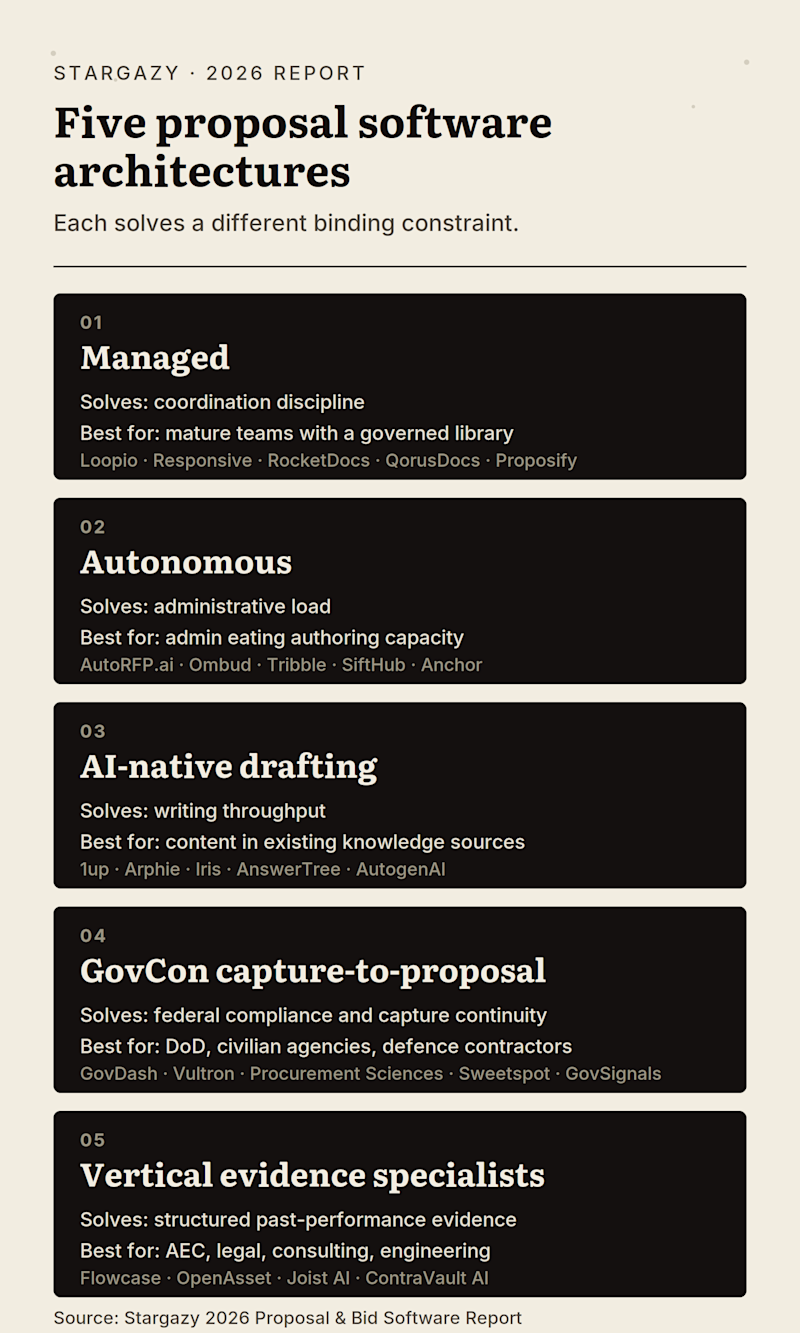
The buying error stargazy documents repeatedly is a team purchasing an AI drafting tool to solve a governance problem, or treating a general-purpose automation tool as proposal technology, or buying a managed platform when the actual constraint is writing throughput. Every mismatch produces the same pattern downstream, that the tool feels wrong by month three, the team works around it by month six, and the company is shopping again by month twelve.
The full vendor snapshot matrix in the 2026 report lists every vendor, their dominant fit, and their industry emphasis. It is the starting point for building a shortlist, after you have diagnosed your own constraint.
Two questions to diagnose your binding constraint
Answer these before the next demo. They resolve most teams into the correct architectural category in under ten minutes.
Question one. How many people touch a proposal before it ships?
A team of one or two has a throughput problem. A team of five has a coordination problem. A team of twelve has a governance problem. Each count points to a different primary architecture.
Question two. What breaks most often: speed, personalisation, coordination, governance, or compliance?
If speed breaks most often, you have a writing throughput constraint. AI-native drafting engines are the category.
If personalization breaks most often (responses read as generic, win rates drop in competitive bids), you have a content architecture problem. AI-native drafting engines with strong retrieval, or autonomous platforms with context enrichment, are the category.
If coordination breaks most often (version conflicts, duplicated edits, contributors stepping on each other), you have a process control problem. Managed or autonomous platforms are the category.
If governance breaks most often (claims that should not have been made, approvals that cannot be reconstructed), you have a trust fidelity problem. Governance-forward platforms in any category are the answer, and the governance capability axis in the 2026 report is the assessment tool.
If compliance breaks most often (regulatory exposure, FOIA risk, FCA investigation risk, CUI handling), you need GovCon capture-to-proposal software for federal work, or a governance-forward managed platform for commercial regulated industries.
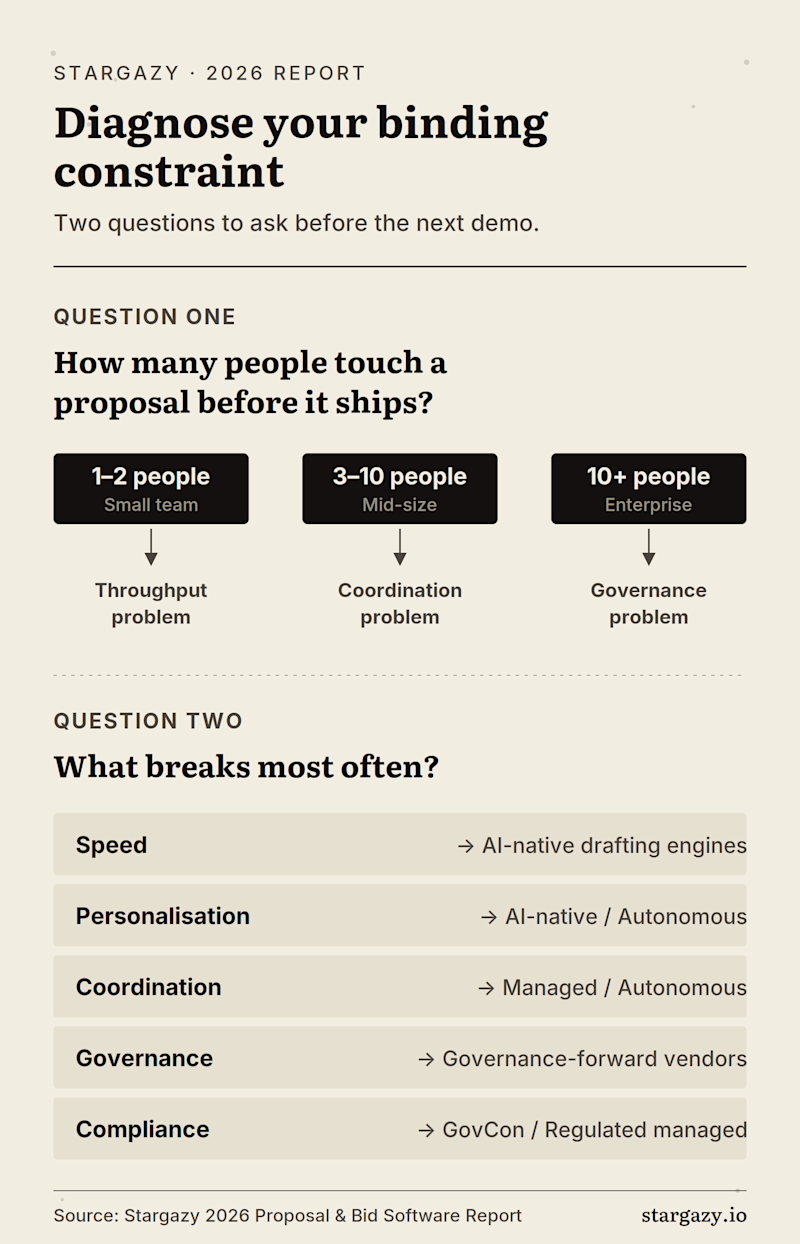
These two questions correspond to six buyer profiles the report analyses in depth, with budget ranges from $6,000 per year for small ad-hoc teams to over $500,000 per year for enterprise GovCon environments. Most commercial mid-market buyers sit between $50,000 and $150,000 per year, depending on response volume and regulatory exposure.
If the two questions point to two different architectures, ask a third: does your team want to own the library and the flow, or do you want the platform to absorb some of the admin? Owning the flow points to managed platforms. Absorbing admin points to autonomous platforms. The rest flows from there.
Trust fidelity separates revenue-safe platforms from revenue-risky ones
Even after the constraint is diagnosed and the category is chosen, one question sits above the shortlist.
Trust fidelity is the degree to which a proposal platform can trace a claim back to a source and require approval from an accountable reviewer before that claim reaches a buyer. It is the variable that separates platforms that reduce revenue risk from platforms that accelerate it.
This matters more in 2026 than it did in 2024 for a specific reason. A majority of B2B purchase influencers now use or plan to use private generative AI tools in procurement, and a measurable share of buyers report less confidence in their decisions after using AI to evaluate vendors. Evaluators are fact-checking RFP responses through their own AI, asking questions like "does this vendor's claim about integration X match their public documentation" or "is this answer consistent with their security posture." Proposals that cannot produce claim-level citations with verifiable source links will fail buyer-side verification even when they pass internal review.
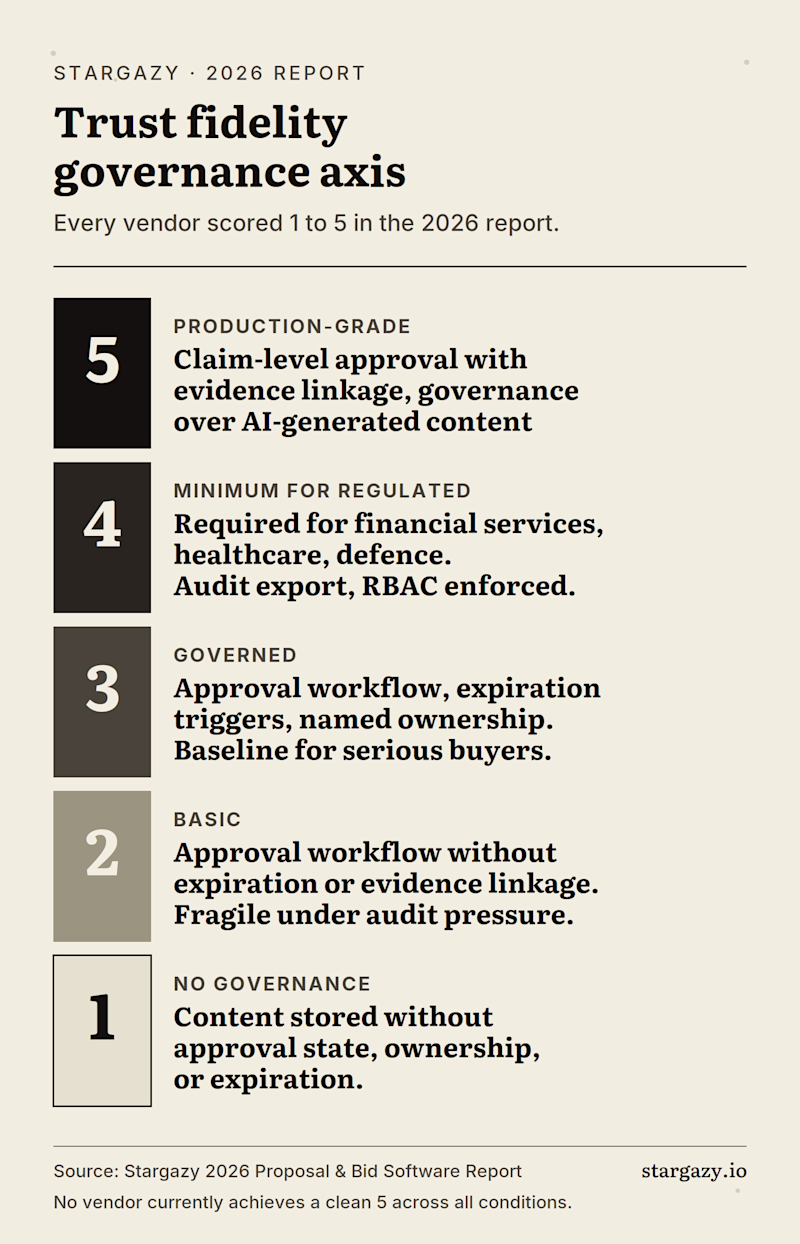
For revenue leaders, this reframes accuracy from a compliance concern into a procurement KPI. The 2026 report assesses every vendor on a governance capability axis scored from one to five. A score of one is no governance, of content stored without approval state, ownership, or expiration, with unrestricted reuse.
A score of five is production-grade governance, where claim-level approval with evidence linkage, automatic expiration triggers, full audit export, role-based access control enforced across integrations, and governance extending to AI-generated content.
Most regulated-industry buyers should require a minimum score of three. Financial services, healthcare, and defence buyers should require four. No vendor in the current market achieves a clean five across all conditions. That is the frontier.
The operational test for trust fidelity takes ten minutes during a pilot. Insert an expired answer into an active response and check whether the platform allows it. Ask the platform to reconstruct the approval chain for a single answer approved six months ago, with named reviewer, timestamp, and evidence link. Revoke a user's permission and check whether that user can still access approved content through the AI layer. A platform that fails these tests under controlled conditions will fail them under audit pressure, too.
Governance is not a separate category in the 2026 report. It is an axis every vendor is scored against, because every category contains governance-forward and governance-light vendors, and the buyer's risk exposure depends on the vendor choice within a category, not the category itself.
Three changes through 2028 that will rewrite the buying calculus
Three patterns will reshape the proposal software market across the next two buying cycles. Revenue leaders planning a purchase in 2026 should factor each one into contract length and category choice.
Orchestration is displacing assistance as the buying standard. Proposal technology is moving through three AI maturity stages. Assistance (the AI helps a human draft) is commoditising fast, as ChatGPT Projects, Claude Projects, and Microsoft 365 Copilot ship retrieval and drafting at a fraction of enterprise proposal software pricing. Orchestration (the AI takes on coordination across intake, retrieval, SME routing, and review state) is the current enterprise frontier and the basis for the autonomous category. Agent systems, where specialised agents coordinate with each other across a structured workflow, are visible on vendor roadmaps and will be in production inside 18 months. A platform that competes on assistance alone in 2026 faces margin compression and buyer defection through 2027.
Accuracy is moving from a marketing talking point to a measurable procurement criterion. The legal reality is already clear. When an AI-generated claim in an RFP response turns out to be false, the vendor is responsible regardless of who or what wrote the words. US federal contractors face False Claims Act exposure. UK and EU suppliers face contractual breach and public-sector debarment. Financial services firms face regulatory filings that treat proposal content as evidence. Gartner projects that guardian agents, a category of AI systems that supervise other AI systems, will capture 10 to 15 percent of the agentic AI market by 2030. Inside proposal workflows, guardian agents will audit drafting engines for unbacked claims before submission. Platforms that expose their reasoning and abstention signals through open interfaces will integrate with guardian layers. Closed platforms will get routed around.
Capture and response are converging into one workflow. In both commercial B2B and federal B2G work, the boundary between opportunity intelligence, qualification, proposal production, and contract negotiation is collapsing. High-performing teams want a single context carrying from first pursuit signal to final submission. Managed and autonomous platforms are building downstream into capture. GovCon capture vendors are building upstream into response. By 2028, teams that keep capture, qualification, and proposal work in separate systems will recreate discovery friction inside every pursuit. Revenue leaders signing three-year contracts in 2026 should ask whether a vendor's roadmap reaches the adjacent control surface.
Where proposal software sits in the revenue operating model from here
The visibility gap is closing. The question is whether revenue leaders close it deliberately, with a platform chosen for the binding constraint and scored on trust fidelity, or whether finance and procurement force the conversation after the first compliance event, contract dispute, or public buyer-side accuracy failure.
Productivity is the number one revenue-leader growth strategy for 2026, up from fourth the prior year. Teams using revenue-specific AI produce 77% more revenue per rep, according to Salesforce's State of Sales research. The CRO and the Chief of Staff to the CRO are increasingly the decision owners on proposal technology, not procurement and not IT. That shift changes which questions get asked in an evaluation, and it changes which platforms survive a serious pilot.
The 2026 proposal software market has five architectures, one governance axis, and a set of failure modes with names. Revenue leaders now have a vocabulary for a category that until recently was run entirely by proposal managers reporting into operations. The instrumentation gap closes when the vocabulary gets used at the revenue leadership table.
Buying the wrong architecture moves work to the most expensive people on your team, later in the cycle, under deadline pressure. Buying the right one closes the last blind spot in your revenue stack.
✹
Frequently asked questions
Does AI improve RFP win rates?
Not on its own. Stargazy's analysis of proposal technology adoption, supported by McKinsey and Stanford research on human-AI collaboration, finds that AI tool adoption alone shows no independent predictive power on win rates once structural and process variables are controlled. The teams that see win-rate gains from AI are the ones that redesigned their intake, SME engagement, and review workflows around it. The teams that bolted AI onto existing workflows saw throughput gains with no measurable lift in wins.
What is trust fidelity in proposal software?
Trust fidelity is the degree to which a proposal platform can trace a claim back to a source and require approval from an accountable reviewer before that claim reaches a buyer. It is the variable that determines whether a platform reduces revenue risk or accelerates it. Stargazy's 2026 Proposal & Bid Software Report scores every vendor on a governance capability axis from one (no governance) to five (production-grade governance extending to AI-generated content). Regulated buyers should require a minimum score of three, with four or five for financial services, healthcare, and defence.
How much does proposal management software cost?
Pricing ranges from approximately $6,000 annually for ad-hoc teams up to over $500,000 annually for enterprise GovCon environments with FedRAMP High requirements. Most commercial mid-market teams spend between $50,000 and $150,000 per year depending on response volume, team size, and regulatory exposure. Regulated commercial teams in pharmaceuticals, healthcare, and financial services typically spend $60,000 to $300,000 per year once security and compliance overhead is included.
What is the difference between managed and autonomous proposal platforms?
Managed platforms enforce coordination discipline for teams that already have a mature process. The team operates the process; the platform coordinates and provides optional AI assistance. Autonomous platforms absorb the administrative work of running a proposal, with AI as the default mover and humans reviewing, approving, and handling exceptions. The dividing question is whether your team wants to own the library and the flow (managed) or whether you want the platform to absorb admin so authoring capacity goes further (autonomous).
Should a CRO care about proposal software?
Yes. It is the one surface in the revenue stack with direct authority over what the company commits to a buyer contractually. It is also the system where buying the wrong architecture wastes budget and moves work onto the most expensive people on the team, later in the cycle, under deadline pressure. With productivity now the top revenue-leader growth strategy for 2026, the proposal function has become a measurable productivity lever rather than a back-office cost.
How do I know if my team needs AI drafting software or a full workflow platform?
Count the number of people who touch a proposal before it ships. One or two people points to a throughput problem, which an AI-native drafting engine will fix. Five or more points to a coordination problem, which a managed or autonomous platform will fix. Then name the thing that breaks most often. If it is speed, choose drafting. If it is coordination or governance, choose a workflow platform. If both are broken, fix the coordination constraint first. It compounds faster than the throughput one.
Sources
Stargazy,
2026 Proposal & Bid Software Report, April 2026.
McKinsey & Company,
The State of AI, 2025.
Stanford Institute for Human-Centered Artificial Intelligence,
AI Index Report, 2025.
Gartner research on agentic AI and guardian agents, 2025.
Salesforce,
State of Sales Report, 2025.
OMB Memoranda M-25-21 and M-25-22, April 2025.
NIST, Generative AI Profile (AI 600-1), 2024.

Christina Carter
I’m the founder of stargazy, the intelligence network for capture and proposal professionals. With 15+ years of running presales and proposal teams for B2B Enterprise, UK Public Sector, and US GovCon around the globe.