GovCon platform consolidation has started, and buyers are about to lose their best negotiating position

Published on June 15, 2026
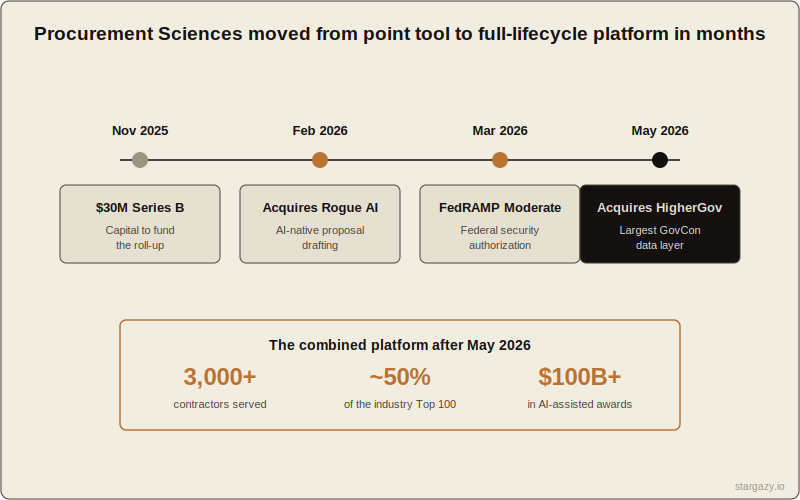
On 20 May 2026, Procurement Sciences acquired HigherGov. The deal pairs Awarded AI, a FedRAMP-authorized platform for capture and proposal work, with the largest government contracting data source on the market. The combined company now serves more than 3,000 contractors, including close to half of the industry Top 100.
Read past the press release and we'll see the data layer and the response layer are merging into one product, and buyers who built their stack on best-of-breed are about to find that option closing.
The assumption buyers still hold
For years the working model in GovCon tooling was modular. You bought market intelligence from one vendor, capture and proposal software from another, pricing benchmarks from a third, and you stitched them together. The logic held because no single vendor owned both the data and the workflow. Switching one component was cheap. If HigherGov raised prices, you could move your opportunity tracking elsewhere and keep your proposal tool. That separation was the buyer's leverage.
The acquisition removes the separation by design. Christian Ferreira, the Procurement Sciences founder, framed it as data access being the single biggest constraint on pushing their agents further, and now they have unrestricted access to it. The data is becoming the fuel the workflow runs on.
What changed in the deal
Three things are worth tracking, in our humble stargazy opinion:
-
The integration is one-directional in value terms. HigherGov's federal, state, local, and grant data flows into Awarded AI's drafting, pricing, and compliance agents, which means the platform's output improves in ways a standalone intelligence tool cannot match.
-
Both products keep running as standalone offerings for now, with no disruption promised to existing customers. That is the standard reassurance after an acquisition, and it has a shelf life.
-
This is the company's second GovCon acquisition in three months. It bought Rogue AI, an AI-native proposal drafting tool, in February 2026, and folded HigherGov in by May. The pattern is a company buying its way to end-to-end coverage rather than building it.
The same forces are shaking out the bottom of the market
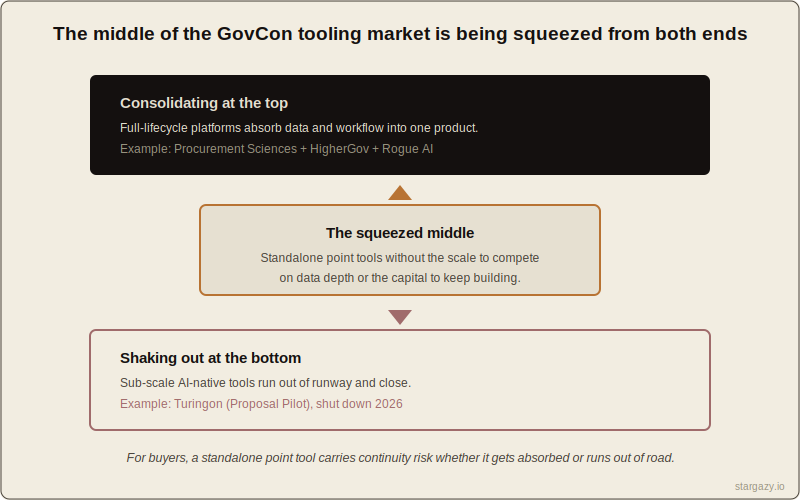
Consolidation at the top has a mirror image at the bottom. Turingon, an AI-native federal proposal tool that launched Proposal Pilot in 2025, announced it was shutting down in June 2026. A compliance-first drafting tool with credible GovCon founders could not reach the scale the category now demands. The lesson for buyers runs in both directions, in that betting on a standalone point tool carries real continuity risk, whether that tool gets absorbed into a larger platform or simply runs out of road.
The new shape of the category
GovCon tooling is consolidating into full-lifecycle platforms that own discovery, capture, drafting, pricing, and win analysis under one roof. The pitch to buyers is of one secure environment, one data spine, agents that act on intelligence the moment it lands rather than after an analyst exports a spreadsheet. For contractors drowning in fragmented tools and manual handoffs, that coherence has genuine value.
The cost is concentration. When one vendor owns both the opportunity data and the proposal engine, the buyer's exit cost rises sharply. You are switching a data dependency that feeds every downstream agent you have come to rely on.
This is the Win Intelligence problem stated in procurement terms, as the advantage moves to whoever controls the structured data behind the response, and control is what consolidation concentrates.
Who benefits and who should worry
Large contractors with the budget for an enterprise platform and the volume to justify it come out ahead.
They get coverage they would otherwise assemble from five contracts, and they have the leverage to negotiate terms even inside a consolidated vendor.
Small and mid-size contractors are the exposed group. They adopt the all-in-one platform because it is easier than integration, then find their pricing intelligence, opportunity data, and proposal workflow all sitting with a single supplier whose incentives no longer require them to compete on any one layer.
What this means for your next decision
If you are buying GovCon software in 2026, price the lock-in before the convenience. Ask where your opportunity data lives, who owns it, and what leaving costs you in workflow rebuild, not just subscription fees.
If you already run HigherGov as a standalone, the standalone promise is worth monitoring rather than trusting. Watch for the moment the better features land only inside the combined platform, because that is when the migration pressure starts.
Consolidation in this category is not finished. This is the first large move, and the buyers who keep their leverage will be the ones who treated their data layer as the asset, not the afterthought.
The full vendor breakdown across the GovCon segment sits in the 2026 Proposal & Bid Software Report.
🌟
Frequently asked questions
What did Procurement Sciences acquire and when?
Procurement Sciences acquired HigherGov on 20 May 2026. The deal combined Awarded AI, its FedRAMP Moderate authorised capture and proposal platform, with HigherGov's government contracting market intelligence data. It followed the company's February 2026 acquisition of Rogue AI.
What is GovCon platform consolidation?
It is the merging of tools that government contractors used to buy separately, opportunity data, capture, proposal drafting, pricing, and win analysis, into single full-lifecycle platforms. The Procurement Sciences and HigherGov deal pairs the largest GovCon data source with an AI-native proposal engine in one product.
Why does consolidation matter for proposal buyers?
When one vendor owns both the opportunity data and the proposal workflow, switching costs rise. A buyer is no longer changing a single tool but unwinding a data dependency that feeds every downstream agent. That reduces the buyer's leverage on price and roadmap.
Which buyers are most exposed?
Small and mid-size contractors. They tend to adopt all-in-one platforms because integration is hard, then find their data and workflow concentrated with one supplier that no longer has to compete on any single layer. Large contractors with budget and volume retain more negotiating power.
What should a buyer do before signing?
Price the lock-in before the convenience. Confirm where opportunity data lives, who owns it, and what leaving would cost in workflow rebuild rather than subscription fees alone. Treat "continues as standalone" promises as conditions to monitor, not guarantees.
Is this consolidation finished?
No. The Procurement Sciences and HigherGov deal is the first large move in the category. The same pressure is closing weaker point tools at the bottom of the market, so buyers should expect further acquisitions and shutdowns through 2026.
Sources
-
Procurement Sciences, "Procurement Sciences Acquires HigherGov, Creating the Largest AI-Powered Growth Platform in Government Contracting," PR Newswire, 20 May 2026.
-
Procurement Sciences, "Procurement Sciences Acquires HigherGov: One Platform to Find and Win Government Contracts," company blog.
-
ExecutiveBiz, "Procurement Sciences Acquires HigherGov," May 2026.
https://www.executivebiz.com/articles/procurement-sciences-highergov-acquisition-ai-govcon
-
Procurement Sciences, "Procurement Sciences Acquires Rogue AI," PR Newswire, 19 Feb 2026.
-
ExecutiveBiz, "Procurement Sciences Achieves FedRAMP Moderate ATO," March 2026.
https://www.executivebiz.com/articles/procurement-sciences-fedramp-moderate-ato
-
Turingon, "Turingon Unveils Proposal Pilot," Business Wire, 10 June 2025.
(shutdown reported via founder LinkedIn announcement, 2026)

Christina Carter
I’m the founder of stargazy, the intelligence network for capture and proposal professionals. With 15+ years of running presales and proposal teams for B2B Enterprise, UK Public Sector, and US GovCon around the globe.