AI Proposal Tools Win Rate Data | 2026 Benchmarks

Published on April 4, 2026
Why AI proposal tools don't improve win rates (and what actually does)
Proposal teams that adopt AI tools and proposal teams that do not adopt AI tools report almost identical win rates once you control for operational maturity. That is the central finding from the Stargazy x AutoRFP.ai 2026 Proposal Win Rate Report, a survey of 97 bid and proposal professionals with 90 providing verified win-rate data for cohort analysis.
The implication is uncomfortable for a market that has spent the last two years selling AI as a win-rate lever. Across the dataset, 65% of high-win teams reported using AI proposal technologies. That sounds like a strong signal until you notice that AI adoption among low-win teams was not far behind. The gap between high and low performers on AI adoption was the narrowest of any practice area measured. Qualification discipline, win theme usage, customer insight, and bid ownership all showed wider separation between winners and losers.
AI is present on winning teams. It is also present on losing teams. The data points to a different variable entirely.
Methodology and context
The 2026 Proposal Win Rate Report surveyed 97 bid and proposal professionals, with 90 providing verified win-rate data used for cohort analysis. Respondents spanned enterprise and mid-market organizations, with 37% selling primarily to the public sector and 23% primarily to the private sector. The most common team structure was two to five people, regardless of win rate cohort.
The sample skews toward organisations where proposals are a defined function, not an ad hoc task. That matters because it means even the low-win cohort includes teams with some level of proposal investment. The findings, therefore, reflect differences between teams that both take proposals seriously, not between teams that care and teams that do not.
Limitation worth stating: the survey did not control for deal size, vertical complexity, or the specific AI tools in use. These are confounding variables that could shift the picture. The findings describe correlations, not proven causal relationships.
Finding 1: AI adoption is the weakest differentiator
Of all the practices measured in the report, AI tool adoption showed the smallest percentage-point gap between high-win and low-win teams. High-win teams reported 65% AI adoption. The gap between cohorts on this measure was roughly 15 percentage points.
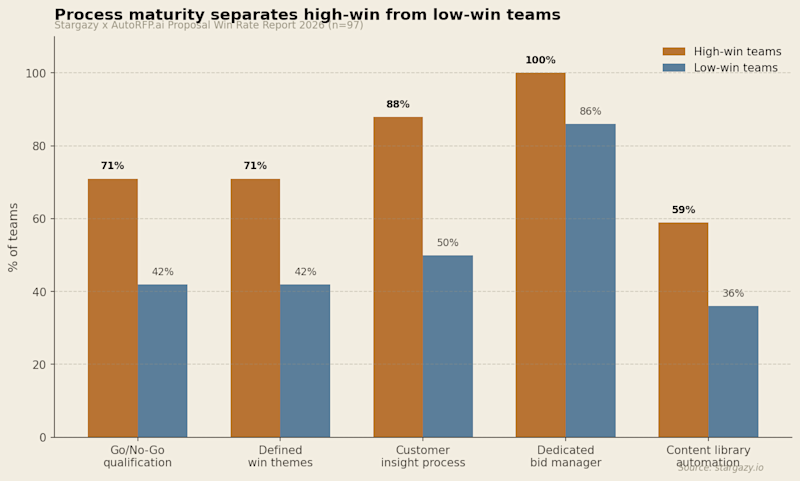
Contrast that with the process-driven practices. Go/No-Go qualification discipline showed a 29-percentage-point gap (71% of high-win teams versus 42% of low-win teams). Win theme usage showed the same 29-point spread. Customer insight processes showed a 38-point gap (88% versus 50%). Dedicated bid ownership showed near-universal adoption among high performers, with 100% of high-win teams reporting a dedicated bid manager compared to 86% of low-win teams, and 14% of the low-win cohort reporting no dedicated bid role at all.
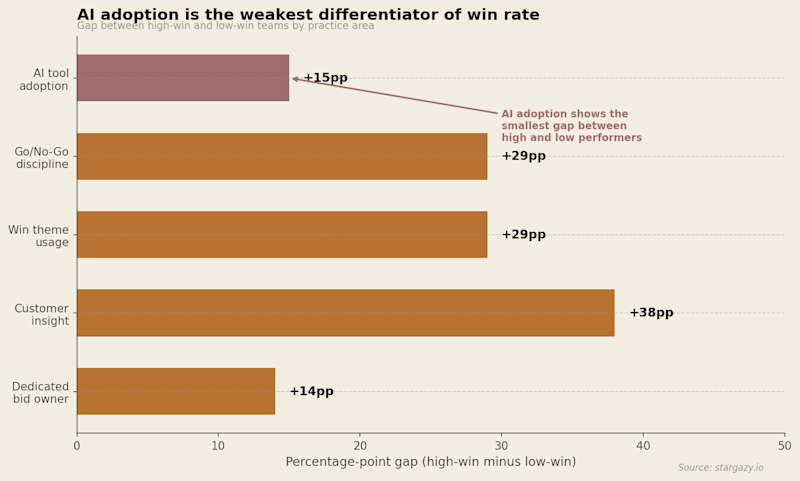
The pattern is clear. AI adoption tells you less about a team's win rate than any of the four process maturity indicators measured. A team that runs formal Go/No-Go qualification, uses defined win themes, and invests in customer insight before writing is more likely to win than a team that has adopted AI but skips those steps.
Finding 2: process maturity is what actually tracks with winning
The report's high-win cohort shares four operational characteristics that the low-win cohort lacks. These are not sophisticated capabilities. They are basic proposal management disciplines that have been taught in APMP certification courses for over a decade.
AI proposal tool adoption does not correlate with higher win rates when analysed independently of operational factors. According to Stargazy and AutoRFP.ai's 2026 Proposal Win Rate Report (n=97), the practices that separate high-win from low-win teams are process-driven: Go/No-Go qualification discipline, defined win themes, structured customer insight, and dedicated bid ownership.
First, qualification discipline. 71% of high-win teams enforce a formal Go/No-Go step before committing resources. That discipline means fewer proposals submitted, but each one receives more attention, better tailoring, and stronger competitive positioning. Teams that bid on everything dilute effort across opportunities they were never going to win.
Second, win themes. 71% of high-win teams define explicit win themes before writing begins. The report found teams with defined win themes achieve an average win rate of 37% compared to 29% for teams without. Win themes force strategic thinking before drafting starts. Without them, proposal teams write descriptions of their product instead of arguments for why the buyer should choose them.
Third, customer insight. 88% of high-win teams have a defined process for gathering and documenting customer intelligence before the RFP response begins. This is the widest gap in the entire dataset. Knowing the buyer's priorities, constraints, and evaluation criteria before writing changes every section of the proposal.
Fourth, dedicated ownership. Every high-performing team in the sample had a dedicated bid manager. Among low performers, 14% had no dedicated bid role. Without ownership, proposals become a distributed side task that nobody prioritises.
Finding 3: compliance-heavy verticals expose the pattern most clearly
The report's vertical analysis reinforces the process maturity thesis. In compliance-heavy regulated industries, win rate variance is widest, and it maps to operational discipline rather than tool selection.
The AEC (architecture, engineering, construction) data is instructive. Among AEC respondents, 71% reported new-client win rates in the 25% to 49% range, with only 21% winning above 50%. AEC firms reported strong AI-driven efficiency gains in drafting speed, staff time allocation, and throughput. But only 35% of respondents across the full sample linked AI adoption to higher win rates or greater revenue.
AI helped AEC teams produce more proposals faster. It did not help them produce better-positioned, more evaluator-aligned, or more differentiated responses. The reason is that compliance-heavy environments penalise process gaps more severely. A missed requirement in a regulated procurement is disqualifying. Speed without accuracy accelerates failure.
The verticals where AI delivered the weakest win-rate signal were the same verticals where process maturity delivered the strongest. That is not a coincidence. When evaluation criteria are rigorous and scoring is structured, the team with better pre-bid preparation outperforms the team with faster drafting.
What the data does not tell us
This analysis has limits that matter.
The report did not measure which AI tools teams used or how deeply they were embedded in the workflow. A team that uses AI for first-draft generation only is in a different position from a team that uses AI across qualification, compliance checking, content governance, and response generation. The binary "adopted AI / did not adopt AI" measure flattens important variation.
The data does not control for team size, deal value, or proposal complexity. A five-person team responding to 200 RFPs per year faces different constraints from a 20-person team responding to 50. AI's impact may vary across these conditions in ways the current dataset cannot isolate.
Finally, correlation is not causation. The finding that process maturity tracks with higher win rates does not prove that adopting Go/No-Go discipline will raise your win rate by a specific amount. It suggests that the two are linked, and the strength of the correlation across multiple practice areas makes the relationship difficult to dismiss.
What to do with this
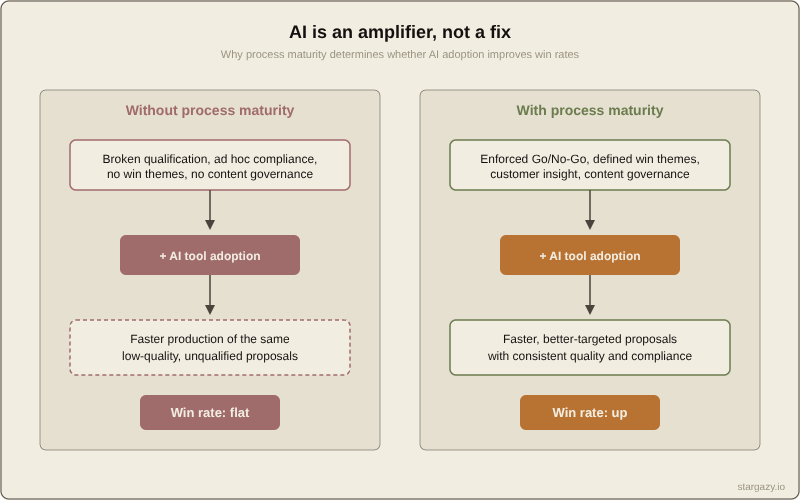
If you are mid-evaluation on AI proposal tools, the data suggests a sequencing question rather than a buying question. The question is not "which AI tool should we buy?" It is "do we have the operational foundation that would let AI actually improve our outcomes?"
Four diagnostic checks, drawn directly from the report's high-win cohort profile:
-
Does your team enforce a formal Go/No-Go qualification step that actually disqualifies opportunities? If fewer than 20% of your opportunities are declined, the gate is not working.
-
Does every proposal start with documented win themes tied to the buyer's evaluation criteria? If your team starts with product descriptions, AI will generate faster product descriptions. That does not change the score.
-
Do you have a structured customer insight process that produces a brief before writing begins? The 38-point gap on this measure is the largest in the dataset. This is where the money is.
-
Does one person own each proposal end-to-end? If ownership is distributed across sales, presales, and marketing with no single accountable lead, AI will speed up a process that has no direction.
If you answer no to two or more of those questions, investing in process maturity before (or alongside) AI adoption is likely to produce a larger win-rate return than the technology alone.
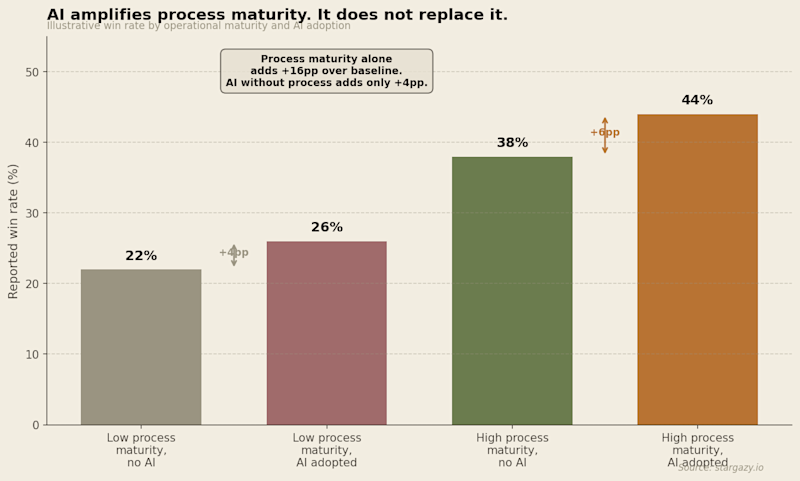
As Stargazy's analysis of AutoRFP.ai's approach to proposal content explored in a recent episode of The Stargazy Brief, the best AI tools assume you have a system worth accelerating. They do not build that system for you.
The full methodology, cohort breakdowns, and vertical analysis are available in the 2026 Proposal Win Rate Report. Stargazy's 2026 Proposal and Bid Software Report evaluates 42 vendors across the proposal technology category, including how each platform supports the operational practices that the win rate data identifies as the real differentiators.
✹
Frequently asked questions
Do AI proposal tools improve win rates?
According to the Stargazy x AutoRFP.ai 2026 Proposal Win Rate Report (n=97), AI adoption alone does not correlate with higher win rates. The practices that separate high-win from low-win teams are process-driven: Go/No-Go qualification, defined win themes, customer insight, and dedicated bid ownership. AI amplifies existing operational quality but does not replace it.
What is the average proposal win rate in 2026?
Industry benchmarks vary by source. The Loopio/APMP RFP Response Trends Report reports an average of 39% to 45% depending on the measurement period. The Stargazy x AutoRFP.ai report found that teams with mature operational processes, including win themes and qualification discipline, reported average win rates of 37%, while teams without these practices averaged 29%.
What proposal management practices have the strongest correlation with win rates?
Based on the 2026 Proposal Win Rate Report, customer insight processes showed the largest gap between high and low performers (38 percentage points), followed by Go/No-Go qualification and win theme discipline (both 29 percentage points). AI tool adoption showed the smallest gap of any practice measured.
Should I invest in AI proposal tools or process improvement first?
The data suggests process maturity first. AI multiplies existing operational quality. If your team lacks qualification discipline, win themes, or customer insight processes, AI will accelerate a broken workflow rather than fixing it. The highest-return investment is building operational foundations first, then adding AI to amplify them.
How do compliance-heavy verticals perform differently?
Regulated industries and compliance-heavy procurement environments show the widest win rate variance in the dataset, and the variance maps to process discipline rather than tool sophistication. Only 35% of respondents linked AI adoption to higher win rates. AI improved speed and throughput but did not improve evaluator alignment or competitive differentiation.
What does process maturity mean for a proposal team?
Process maturity in proposal operations refers to a team's adoption of repeatable, enforced practices: formal bid qualification, documented customer intelligence before writing, defined win themes, dedicated proposal ownership, structured review cycles, and governed content reuse. These practices exist independently of any technology platform.
✹
Sources
-
Stargazy x AutoRFP.ai, 2026 Proposal Win Rate Report (n=97). Available at: https://autorfp.ai/blog/rfp-statistics
-
Loopio and APMP, 2026 RFP Response Trends and Benchmarks Report. Available at:
-
Stargazy, 4 Numbers Every AEC Proposal Leader Should Know in 2026. Available at:
https://stargazy.io/resources/4-numbers-every-aec-proposal-leader-should-know-in-2026
-
The Stargazy Brief, 7 Myths About Proposal Content Libraries with Jasper Cooper (
AutoRFP.ai). Available at:
https://stargazy.io/podcasts/proposal-content-library-myths-jasper-cooper

Christina Carter
I’m the founder of stargazy, the intelligence network for capture and proposal professionals. With 15+ years of running presales and proposal teams for B2B Enterprise, UK Public Sector, and US GovCon around the globe.