8 findings every AEC proposal leader should act on in 2026
Published on November 17, 2026
By Christina Carter, founder of stargazy · Last updated 16 November 2026
Every figure in this post comes from The State of Experience Data in Proposals 2026, stargazy's survey of 429 proposal, marketing and business development professionals at architecture, engineering, construction and professional services firms, fielded July to October 2026 and sponsored by Flowcase.
Key takeaways
About half of the 429 AEC and professional services professionals surveyed say their firm has declined to bid because it could not demonstrate sufficient relevant experience.
Relevant past experience is the top win factor, cited by 64%, yet only 12% keep proposal content in a structured, queryable database.
52% spend a day or more assembling experience content for a single major proposal, and 22% spend more than two days.
Firm leaders are 20 points more confident than their proposal and marketing teams that relevant experience can be found when a bid demands it (78% against 58%, p < 0.001).
56% of proposal teams use or pilot AI, while 46% lack confidence that their proposal data is clean enough to give it accurate inputs.
AEC firms lose work they never bid on. In stargazy's 2026 survey of 429 proposal professionals, about half say their firm has passed on a bid because it couldn't prove relevant experience, and only 12% store that experience in a structured, queryable database.
AEC firms rank experience above every other win factor, and yet they put little time, effort, or budget into taking care of that sales asset.
Of the 429 professionals stargazy surveyed, 64% put relevant past experience in their top two win factors, while about 60% say their firm's proposal content lives in documents, PDFs or no consistent system at all.
When a firm doesn't respond to an RFP because it couldn't provide proof of a win, that revenue potential isn't usually tracked anywhere. stargazy calls this the invisible no-bid.
The eight findings below walk through the full report, and each one ends with what proposal and marketing teams can do about it this quarter.
Relevant past experience is the top AEC win factor, cited by 64% of respondents
Asked to pick the top two influences on whether their firm wins, 64% of the 429 respondents chose relevant past experience. Relationships came second at 46%. Quality of writing, where most proposal production hours go, ranked near the bottom.
Under qualifications-based selection, public buyers evaluate a design firm's qualifications and experience at the front end of the competition, before price enters the conversation. The scoring weight sits on proof of prior performance, and the production hours sit on prose.
Judy Sparks, CEO of Smartegies, supplied the finding's counterweight in the report. “The firms that consistently win are the ones that build familiarity, demonstrate expertise, and earn trust well before a project becomes an opportunity.” Relationships at 46% support her point, and experience still leads by 18 points.
Evaluators score when you prove to them that you have done the work successfully in the past.
Finding and compiling past experience is the biggest bid challenge, named by 26%
When respondents named their single biggest challenge in preparing bids, 26% chose finding and compiling relevant past experience, the largest share of any option. Tailoring content to the specific client came next. Option order was randomized, so position on the list didn't drive the result.
Across 429 respondents, that is roughly 110 people who put retrieval ahead of deadlines, capacity and internal sign-off. Most proposal technology spending targets drafting speed, a step that starts after the bottleneck this data identifies.
52% of firms spend a day or more assembling experience for one major proposal
Among the 429 respondents, 52% spend about a day or more pulling together experience content for a single major bid, and 22% spend more than two days. Only 14% get it done in under two hours. None of that time produces new content. It goes to locating work the firm has already delivered, written up and been paid for.
A firm submitting 100 major proposals a year at a day of retrieval each commits close to a full-time equivalent to finding things. Much of that time belongs to engineers, consultants and principals whose hours are chargeable elsewhere, so it rarely shows up as a proposal cost, even though it is one.
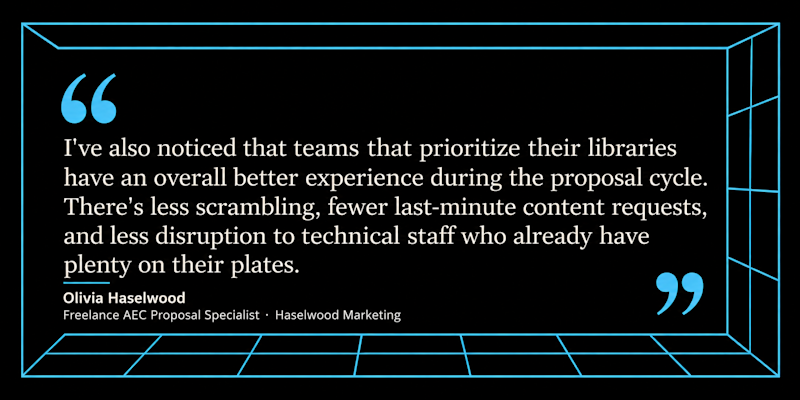
Olivia Haselwood, a freelance AEC proposal specialist at Haselwood Marketing, described the difference she sees across client teams. “Teams that prioritize their libraries have an overall better experience during the proposal cycle. There's less scrambling, fewer last-minute content requests, and less disruption to technical staff who already have plenty on their plates.”
Only 12% keep proposal content in a structured, queryable database
About 60% of respondents say their firm stores proposal content in documents, PDFs or no consistent system. Only 12% report a structured, queryable database. The content exists, which is why confidence stays high. Knowing something exists and being able to find and use it under deadline are separate capabilities, and most firms have built only the first.
The report sorts firms into four levels on the experience data maturity model, using answers any reader can supply without a dataset.
Level | What it looks like | Retrieval time | AI readiness |
|---|---|---|---|
1. Scattered | No agreed location; content on servers, in inboxes and in people's memory | Days | Unsafe to automate |
2. Centralized | One repository, unstructured contents; findable only by those who already know what exists | A day or more | Inputs unreliable |
3. Structured | People and projects held as linked, attribute-searchable records | Hours | Usable with review |
4. Governed | Structured, with a named owner, a defined update schedule and measured currency | Minutes | Inputs trustworthy |
The storage question places about 60% of respondents at Levels 1 and 2 and 12% at Level 3 or above. A firm can buy its way to Level 3. Reaching Level 4 means assigning accountability.
Briana Carter, Pursuit Team Manager for Buildings, US South at Stantec, described what Level 3 looks like in practice. “In A/E/C proposals, clients often want a quick ‘fact sheet’ they can scan for key information, such as construction cost, initial estimates, design and construction durations, and other project metrics. Keeping those facts structured makes it easy for reviewers to quickly assess relevant experience and compliance.”
A library you can only browse stays at Level 2.
Firm leaders are 20 points more confident than their proposal teams that proof can be found
About two-thirds of all respondents say they are confident they can reliably find their most relevant past experience. The same respondents describe locating it as difficult and report assembly times of a day or more.
Split by role, principals, partners and business development leaders report confidence at about 78%, against about 58% for proposal managers, specialists and marketing staff. T
he gap is statistically significant (p < 0.001), based on about 120 leaders and 265 proposal and marketing respondents.
The contradiction survives because teams judge themselves on whether the proposal went out on time, and it almost always does. A principal asks for a project reference and receives one, so the system appears to work. The proposal specialist who spent a day and a half finding it sees a different system.
The people furthest from the search are the most confident in it.
About half of firms have declined to bid because they could not prove relevant experience
About half of respondents say their firm has declined to submit a proposal because it could not demonstrate sufficient relevant experience. In these cases the firm had done the work. It couldn't evidence that work in the time a bid allows. As far as stargazy can establish, no published study has measured this before.
The cost is easy to underestimate because nothing records it. A firm that passes on 8 bids a year for this reason, at a 30% hit rate and an average fee of $400,000, forgoes about $960,000 a year in expected revenue (an illustrative calculation; substitute your own figures). No debrief or win-rate report will ever show that loss.
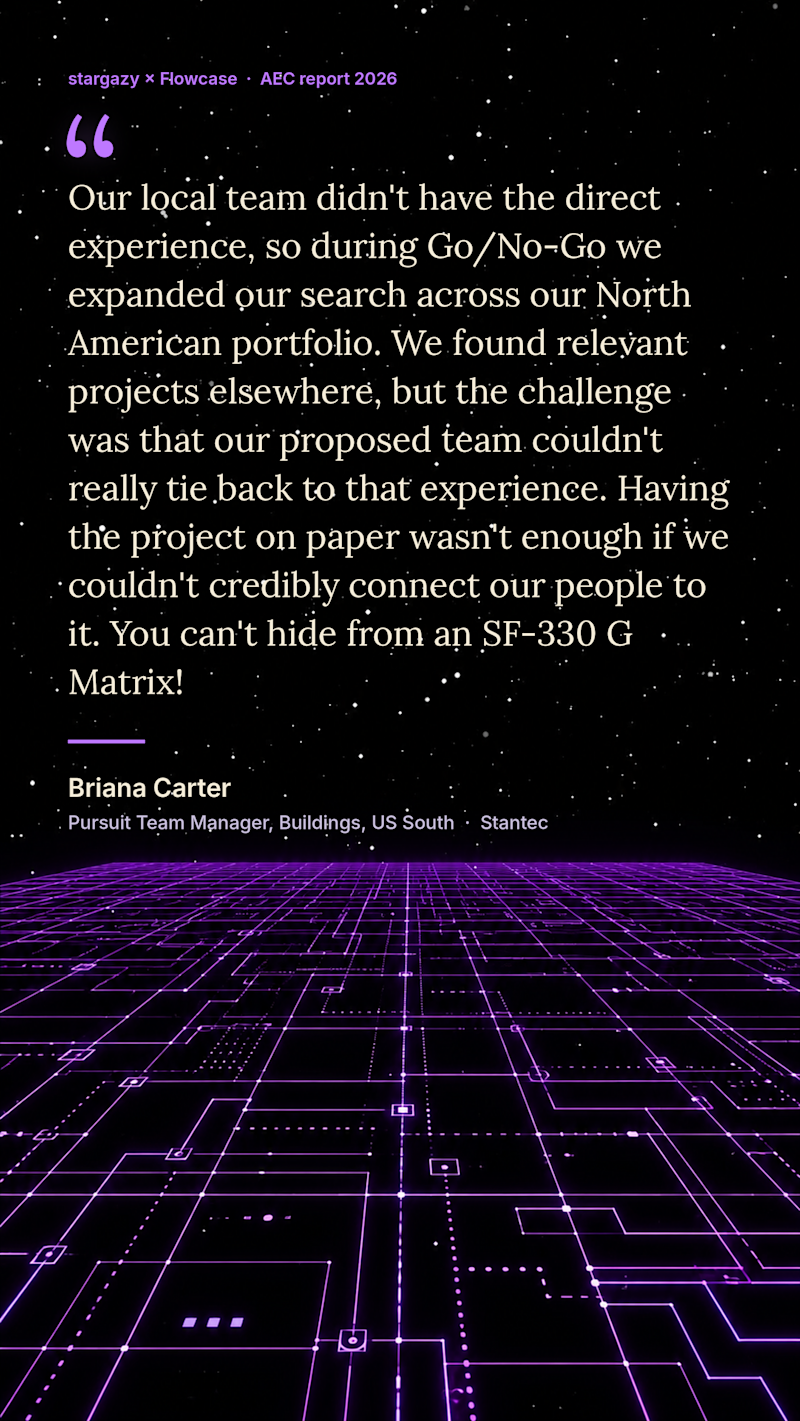
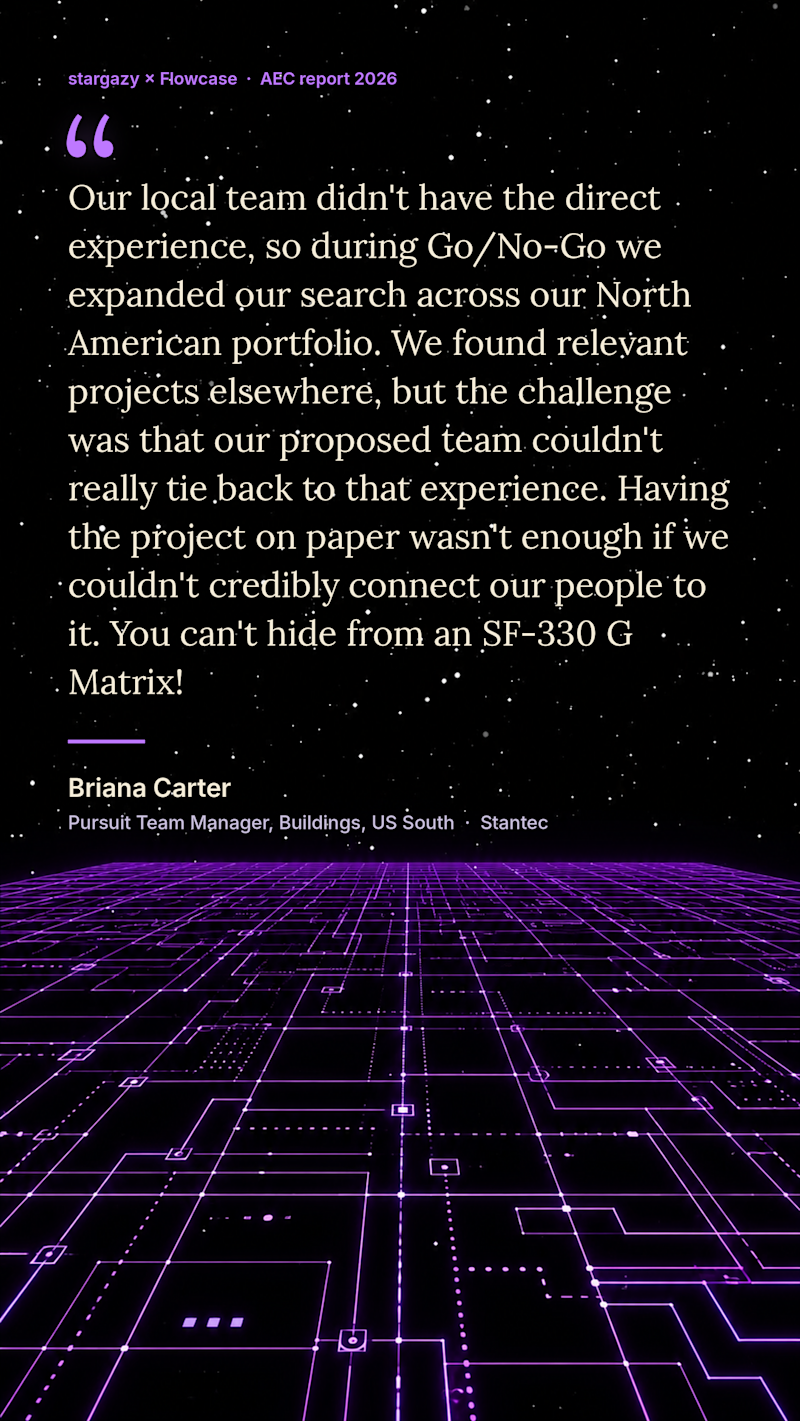
Briana Carter described one such pursuit at Stantec. Her local team lacked direct experience, so they searched the firm's North American portfolio and found relevant projects. “Having the project on paper wasn't enough if we couldn't credibly connect our people to it. You can't hide from an SF-330 G Matrix!”
What you can't prove in time counts the same as work you never did.
What proposal teams should do
For every opportunity declined, record the date, client, estimated value and a reason code, and give “could not evidence experience we have” its own code, separate from “no relevant experience.” Review the ledger each quarter beside your win rate. Within two quarters, you're going to have a lot better idea of why you might be missing out on potential revenue.
56% of proposal teams use or pilot AI, while 46% doubt their data can feed it
In the survey, 30% of proposal teams actively use AI for proposal content and 26% are piloting it, so 56% are using or piloting. Asked whether their proposal data is clean enough to give AI tools accurate inputs, 46% said they are not very or not at all confident. Only 12% are very confident. The two groups overlap substantially, so many firms are automating against content they describe in the same survey as sitting in documents and PDFs.
Half of AI users have already seen the consequence. About half report inaccurate or fabricated proposal content they attribute to disorganized or unreliable source material, and 8% of respondents have tried AI for proposal content and stepped back.
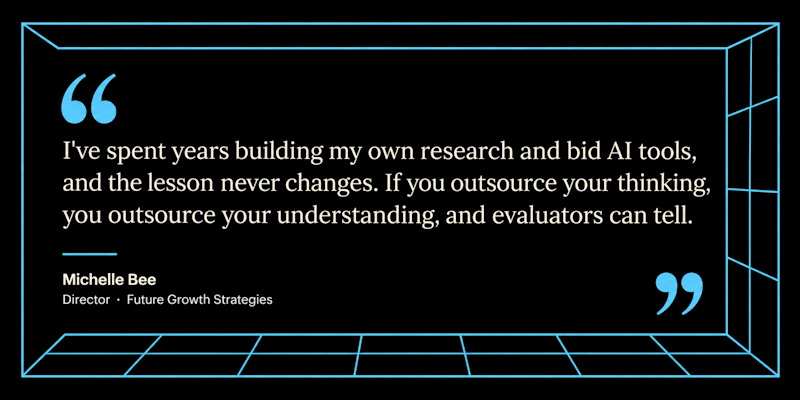
Michelle Bee, Director at Future Growth Strategies, said, AI “will cheerfully invent a KPI or a case study that sounds exactly like something you delivered.”
The exposure is lopsided in this sector, as a fabricated claim in a marketing email is an embarrassment, but a fabricated project reference in a submitted proposal sits in a document the client will hold the firm to.
AI amplifies whatever source material you feed it, errors included.
26% of respondents say their firm does not track its win rate
About 26% of respondents say their firm does not track win rate and they don't know what it is. Among those who can state it, responses cluster between 20% and 60%.
On a team of 8 people producing proposals, that puts about 2 of them working without the one measure that tells them whether their work succeeds. A function that cannot see its own outcome cannot show improvement or justify investment, including the investment the earlier findings call for.
An unmeasured function cannot argue for its own budget.
What proposal teams should do
Before you ask for more proposal capacity, make your win rate available to the people producing the work as well as to leadership. If your firm doesn't calculate it, start with submitted versus awarded over the last 12 months and publish the number internally, however rough. Add the no-bid ledger count beside it.
What to do with these numbers
The report closes with four questions any firm can answer today without a dataset.
How long did your last major proposal take to assemble experience content?
When was your most-used project reference last updated?
Who is accountable for keeping it current, by name?
What is your win rate, and who can state it without asking?
A firm that can't answer the fourth question is operating without the measure every other finding in this report depends on. The full report includes the maturity table and methodology, so you can place your firm and compare it with 429 peers.
✹
Frequently asked questions
How many AEC firms turn down bids because they can't prove their experience?
About half. In stargazy's 2026 survey of 429 AEC and professional services proposal professionals, about half say their firm has declined to bid because it could not demonstrate sufficient relevant experience.
What matters most for winning AEC proposals?
64% of respondents name relevant past experience as a top-two win factor, ahead of relationships at 46%. Quality of writing ranks near the bottom.
How long does it take to pull together project experience for a proposal?
52% of firms take a day or more for a single major bid, and 22% take more than two days. Only 14% finish in under two hours.
Is our proposal content ready for AI?
46% of respondents lack confidence that their data is clean enough for accurate AI inputs, and about half of AI users have seen fabricated content. Firms at Level 1 or 2 of the experience data maturity model should structure content before expanding AI.
What percentage of AEC proposal teams don't know their win rate?
26% of respondents say their firm doesn't track win rate. Those who do report rates clustered between 20% and 60%.
Want to read more?
Read The Stargazy Brief, stargazy's free newsletter for proposal and capture professionals.
Blog post: type: entry-hyperlink id: 7sRlYds8TzUONwCGrLDQVz.
✹
Sources
stargazy and Flowcase, The State of Experience Data in Proposals 2026, November 2026 (n=429, ±4.7 points at 95% confidence), https://stargazy.io/reports/the-state-of-experience-data-in-proposals-2026
American Council of Engineering Companies, Comments on FAR Companion Version 1.0, February 2026, https://www.acec.org/wp-content/uploads/2026/02/ACEC-Comments-on-FAR-Companion-Version-1.0-Final.pdf
Unanet, 2026 AEC Inspire Report press release, June 2026, https://www.constructionowners.com/press-release/unanet-releases-2026-aec-inspire-report-revealing-ai-adoption-surge-while-data-confidence-lags
Disclosure. Flowcase sponsored this research. stargazy wrote the questions and retained full editorial control over the analysis and findings.

Christina Carter
I’m the founder of stargazy, the intelligence network for capture and proposal professionals. With 15+ years of running presales and proposal teams for B2B Enterprise, UK Public Sector, and US GovCon around the globe.